
How to Know What Hair Type You Have: A Complete Guide
If you’ve ever felt like your hair has a mind of its own, you’re in the right place. Figuring out how to know what hair type you have is the absolute first step toward ending those frustrating hair days for good. This isn't just about finding a miracle product, but truly understanding your hair’s unique needs to build a routine that finally works.
Why Understanding Your Hair Type Is a Game Changer
Knowing your hair's specific characteristics is the secret to a hair care routine that actually works. When you finally understand how your hair behaves, you can stop wasting money on products that don’t deliver and start choosing ones that give you real, visible results. It’s the difference between constantly fighting your hair and finally working with it.
Think of this guide as your personal roadmap to decoding your hair’s language. We’re going to cover everything from its curl pattern and porosity to its density and texture. Better yet, we'll walk through simple, practical tests you can do at home to get clear, actionable answers once and for all.
It's just like skincare. You wouldn't use a routine designed for oily skin if your face was dry and flaky, right? The same exact logic applies to your hair. Getting these details right provides the foundation for everything else.
By identifying your complete hair profile, you can customize your routine to solve your specific struggles, whether that’s fighting frizz, boosting limp roots, or locking in much-needed moisture. This knowledge puts you back in control.
Before we dive in, grasping the fundamentals of why hair care is important is the key to unlocking healthier, more manageable hair that you genuinely love. This guide will help you build that foundational knowledge and set you up for long-term success.
Decoding Your Curl Pattern: From Straight to Coily
Knowing your curl pattern is like having the instruction manual for your hair. It’s the single most visible piece of your hair’s identity, and it dictates everything from how you style it to which products will become your holy grails. This isn't just about slapping a label like "straight" or "curly" on your hair—it's about understanding the subtle details that make up the blueprint for your entire routine.
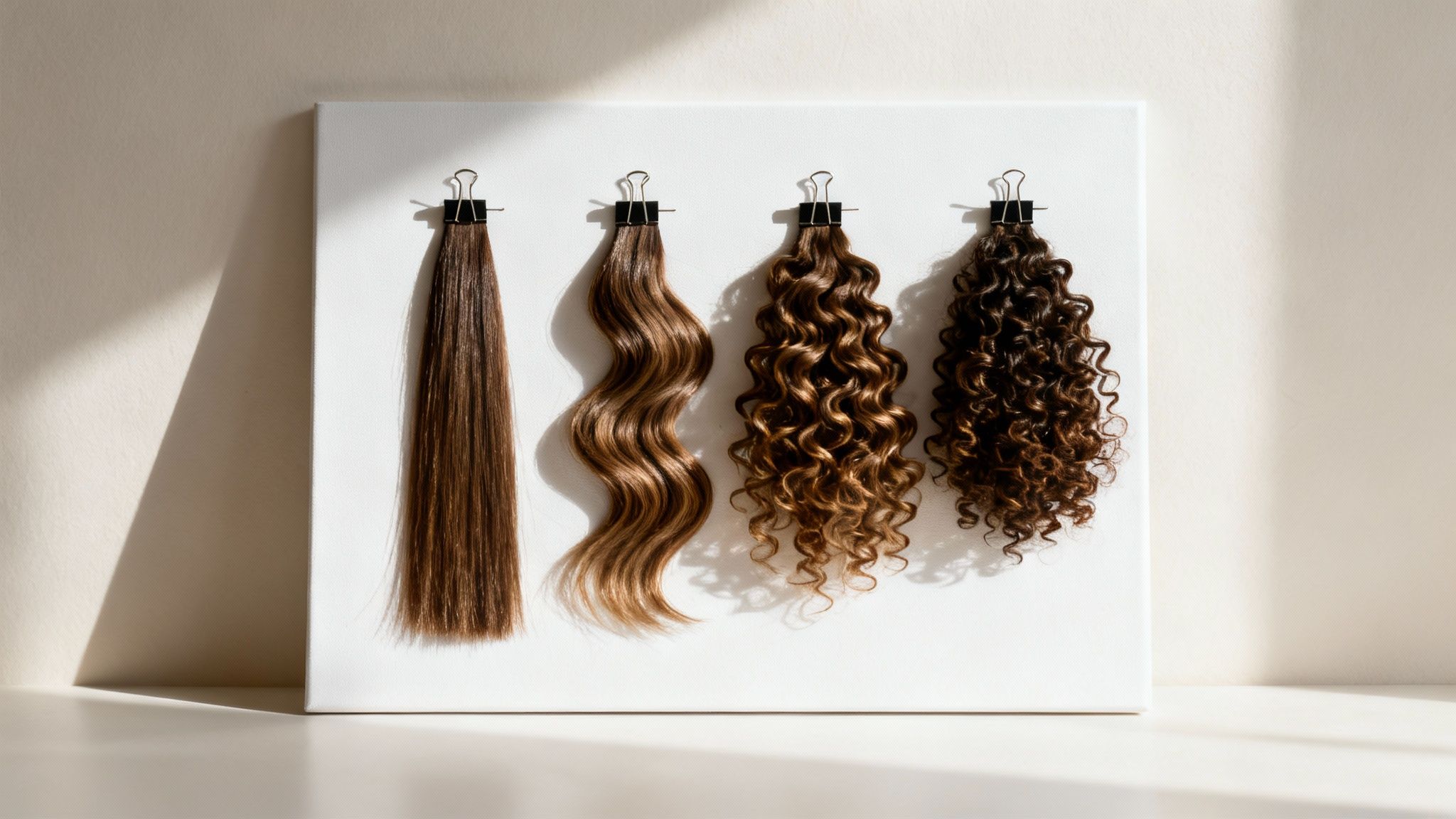
The best way to see what you’re really working with is to observe your hair in its most natural state. All you have to do is wash and gently detangle your hair, then let it air-dry completely. No leave-in conditioners, no oils, no stylers. What you’re left with is your true, unfiltered pattern.
The Four Main Hair Types
The system most people use breaks hair down into four numerical types, each with its own personality. Let's get to know them.
- Type 1 (Straight Hair): This hair type is completely free of any natural curl or wave. Strands fall straight down from the root, no questions asked. It’s often incredibly reflective and shiny but can get oily fast since the scalp's sebum has a straight shot down the hair shaft.
- Type 2 (Wavy Hair): This is where you’ll find a natural, S-shaped bend. It’s not quite straight, but it’s not fully curly either—it lives happily in the middle. The biggest challenge for wavy hair is often frizz, especially when humidity strikes. Heavy products can also easily weigh it down.
- Type 3 (Curly Hair): Now we're talking defined ringlets and spirals. This type ranges from big, loose loops to tight, springy corkscrews. Curls tend to be on the drier side because the scalp's natural oils have a much harder time navigating all those twists and turns.
- Type 4 (Coily Hair): Often called kinky hair, this type has the tightest patterns, from tiny coils to Z-shaped zig-zags. It's the most fragile of all the hair types and is extremely prone to dryness and breakage. Keeping it healthy requires a serious commitment to moisture.
Understanding the A, B, and C Subtypes
Beyond the main numbers, you’ll find the subtypes: A, B, and C. These letters get into the specifics, describing the width and tightness of your pattern. This detail is absolutely critical. After all, a product made for a dense 4C coil would be a disaster for a loose 2A wave.
- Subtype A: Think of this as the widest and loosest pattern in any category. We’re talking about those gentle, tousled 2A waves or the large, loopy curls of 3A hair.
- Subtype B: This is the middle ground. The pattern is more defined and a bit tighter. For example, 2B waves have a more pronounced "S" shape, and 3B curls are classic, springy ringlets.
- Subtype C: Here you’ll find the tightest and smallest patterns. A 2C wave can almost look curly, while 4C coils are so tightly packed that you might not see much curl definition when the hair is dry.
To help you figure out where you land, here's a quick cheat sheet. Wash your hair, let it air-dry with zero product, and see which description matches up best.
Quick Guide to Hair Types and Curl Patterns
| Hair Type | Visual Description | Key Characteristics |
|---|---|---|
| Type 1 | Completely straight from root to tip. | Reflects light well (shiny), prone to getting oily quickly. |
| Type 2A | Gentle, "barely there" tousled waves. | Fine, thin texture that's easily weighed down. |
| Type 2B | Clear S-shaped waves, starting mid-length. | Tends to have some frizz at the crown. |
| Type 2C | More defined S-bends, some pieces may form loose spirals. | Coarser texture, very frizz-prone. |
| Type 3A | Large, loose, well-defined spiral curls. | Curls are about the size of a piece of sidewalk chalk. |
| Type 3B | Springy, voluminous ringlets. | Curls are about the size of a Sharpie marker. |
| Type 3C | Dense, tightly packed corkscrew curls. | Curls are about the size of a pencil or straw. |
| Type 4A | Tightly coiled S-pattern, visible curl definition. | Coils are about the size of a crochet needle. |
| Type 4B | Densely packed strands with a "Z" or zig-zag pattern. | Curls are less defined and bend in sharp angles. |
| Type 4C | Tightly kinked pattern with little to no visible definition when dry. | Experiences the most shrinkage; very fragile. |
Understanding these nuances helps you see the "why" behind your hair struggles and successes. It’s no surprise that over 40% of people worldwide have some form of curl, from waves to coils. This incredible diversity explains why a one-size-fits-all approach is doomed to fail.
Key Takeaway: Identifying both your number and letter (like 2B or 4A) is the foundation for building a routine that actually works. It's the reason a heavy cream might leave fine waves looking greasy, while a lightweight mousse does nothing for dense, coily hair.
If you have a wavy, curly, or coily pattern, fighting frizz is probably a familiar battle. Now that you've pinpointed your curl type, you can start finding solutions that are made for you. Learning how to stop curly hair from frizzing is the perfect next step on your journey to happier, healthier hair.
Uncovering Your Hair's Porosity Level
So you've got a handle on your curl pattern. The next piece of the puzzle, and one of the most critical, is your hair’s porosity. This sounds technical, but it’s really just about how well your hair can soak up and hang onto moisture. Getting this right is often the secret to finally winning the battle against constant dryness, relentless frizz, or that feeling that products are just sitting on top of your hair.
Think of your hair’s cuticle layer like shingles on a roof. For low porosity hair, those shingles are sealed down tight, making it tough for water to get in. For high porosity hair, the shingles are lifted with gaps, letting moisture rush in—but also letting it escape just as quickly.
The Float Test: A Simple At-Home Method
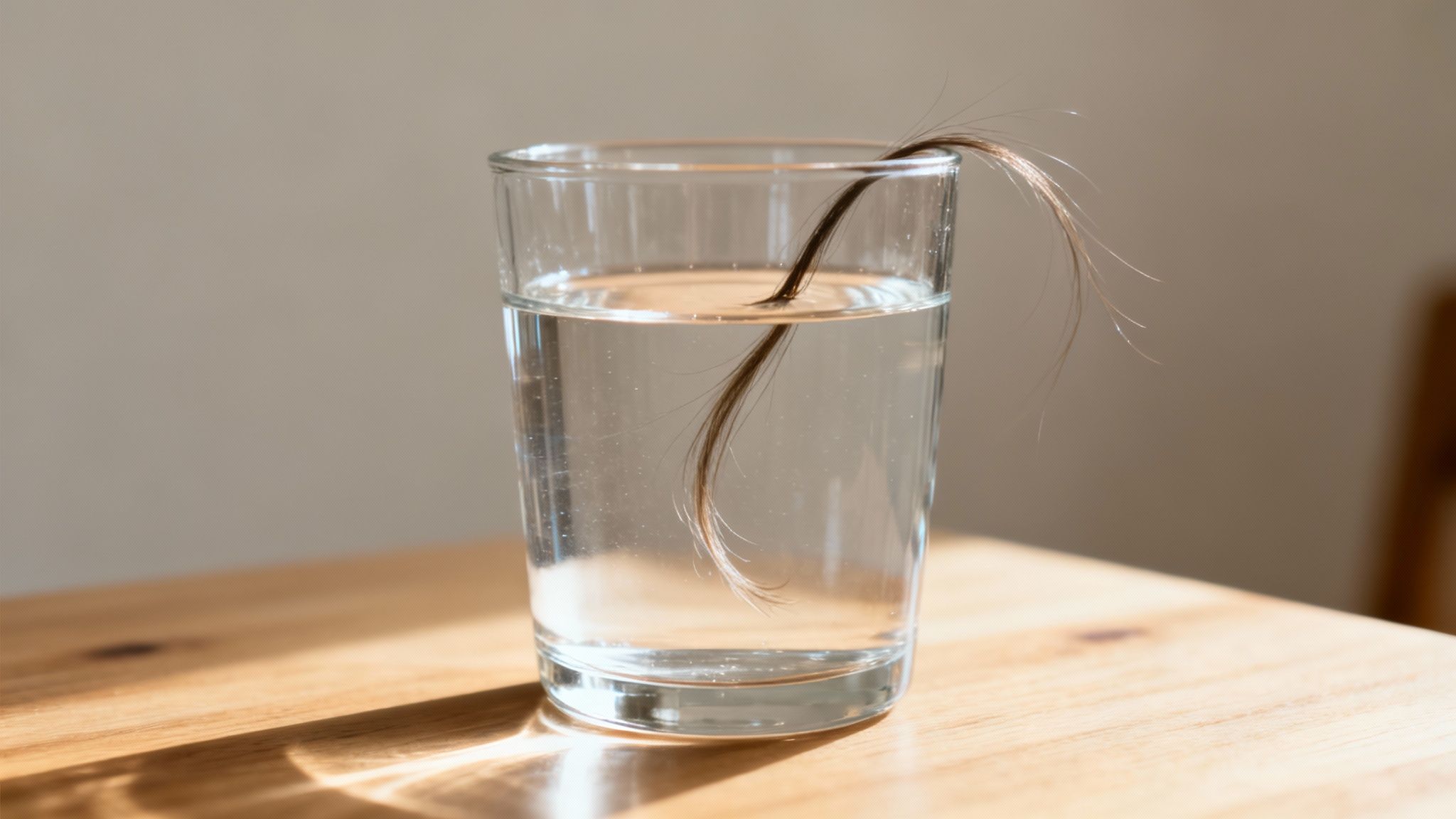
This is the easiest and most well-known way to check your hair's porosity. All you need is a single, clean strand of hair (with no product on it!) and a clear glass of water.
- Drop your clean, dry hair strand into the glass of room-temperature water.
- Watch what it does for the next 2-4 minutes.
The results speak for themselves:
- It floats: If your hair stays floating on the surface, you have low porosity.
- It sinks fast: If it plummets to the bottom right away, you have high porosity.
- It hangs out in the middle: If it hovers somewhere in the middle before eventually sinking, you have medium (or normal) porosity.
This little test is surprisingly insightful. Porosity levels can even give us clues about broader hair characteristics. A floating strand points to low porosity, which is quite common in many straight Asian hair types. A strand that sinks quickly reveals high porosity, a trait often found in coily African hair types, prevalent in 92% of Sub-Saharan populations. You can explore more about these fascinating hair type differences on BelgraviaCentre.com.
What Your Porosity Results Mean for You
Once you know your porosity, you can stop guessing and start picking products that actually work with your hair.
Low Porosity Hair Care
Your biggest hurdle is getting moisture to penetrate that tightly-sealed cuticle.
- Go for Lightweight Products: Heavy butters and thick creams will likely just sit on top of your hair, causing greasy buildup. Stick to lightweight lotions, milks, and serums.
- Use Gentle Heat: Applying products to damp, warm hair can help gently lift the cuticle. Using a hair steamer or a warm towel while deep conditioning is a game-changer.
- Clarify Regularly: Because your hair is prone to product buildup, using a clarifying shampoo once or twice a month is key.
High Porosity Hair Care
Your mission is to get moisture in and then seal the deal so it can't escape.
- Layering is Everything: Methods like the LOC (Leave-in, Oil, Cream) or LCO (Leave-in, Cream, Oil) will be your saving grace. This technique of layering products is designed to trap hydration inside the hair shaft.
- Protein is Your Friend: High porosity hair often has gaps in the cuticle. Protein treatments help temporarily patch those spots, strengthening the hair strand. A fortifying treatment like the Morfose Collagen Hair Mask can work wonders.
- Finish with a Cool Rinse: After conditioning, a final rinse with cool water helps slam the cuticle shut, locking in moisture.
Understanding your hair's relationship with water is the key. You can finally stop the trial-and-error and start giving your hair exactly what it’s been craving. For a deeper dive, check out our guide on the differences between low vs. high porosity hair.
Finding Your Hair's Density and Texture
Beyond your curl pattern and porosity, two other key factors complete your hair profile: density and texture. These terms are often used interchangeably, but they describe two totally different things. Getting this right is the key to understanding why some products give you amazing volume while others just leave your hair feeling flat or greasy.
- Hair Density: This is all about how many individual hair strands you have packed onto your head. Think quantity.
- Hair Texture: This describes the thickness or circumference of each individual hair strand. This is about the size of a single hair.
It's entirely possible to have fine hair that’s incredibly dense, which is why it looks so full. On the flip side, you could have coarse, thick strands but low density, meaning fewer strands overall. Each combination needs its own game plan.
The Scalp Visibility Test for Density
Figuring out your density is super quick. Stand in front of a mirror with dry, clean hair and part it. Now, look closely at your scalp along the part line.
- Low Density: You can see your scalp very easily without moving your hair.
- Medium Density: You can see some of your scalp, but it’s not the first thing you notice.
- High Density: It’s difficult to see your scalp at all through the sheer amount of hair.
If you have lower-density strands and want to boost fullness, learning how to make hair thicker can offer helpful insights.
The Strand Test for Texture
Now for texture. Pluck a single strand of hair and hold it next to a standard piece of sewing thread.
- Fine Texture: Your hair strand is noticeably thinner than the sewing thread. Fine hair is delicate and easily weighed down by heavy creams or oils.
- Medium Texture: Your strand is about the same thickness as the thread. This is the most common texture and it’s usually great at holding styles.
- Coarse Texture: Your hair strand feels thicker and more substantial than the thread. Coarse hair is strong, but it can also be prone to dryness and sometimes resists styling.
Key Insight: Realizing you have fine but dense hair is a lightbulb moment. It explains why you need volumizing products that won't kill your lift. If you have coarse but low-density hair, it means you should focus on rich, moisturizing products to soften your strands without overloading your scalp.
This knowledge is your superpower for picking products. For those with fine hair, for example, mastering how to style fine hair for maximum volume can be a total game changer.
Best Morfose Products to Use for Your Hair Type
Now that you've done the detective work and have a complete profile of your hair, it’s time to build a routine that gives your hair exactly what it needs. This is where you translate knowledge into real-world results, and Morfose has the targeted solutions to help.
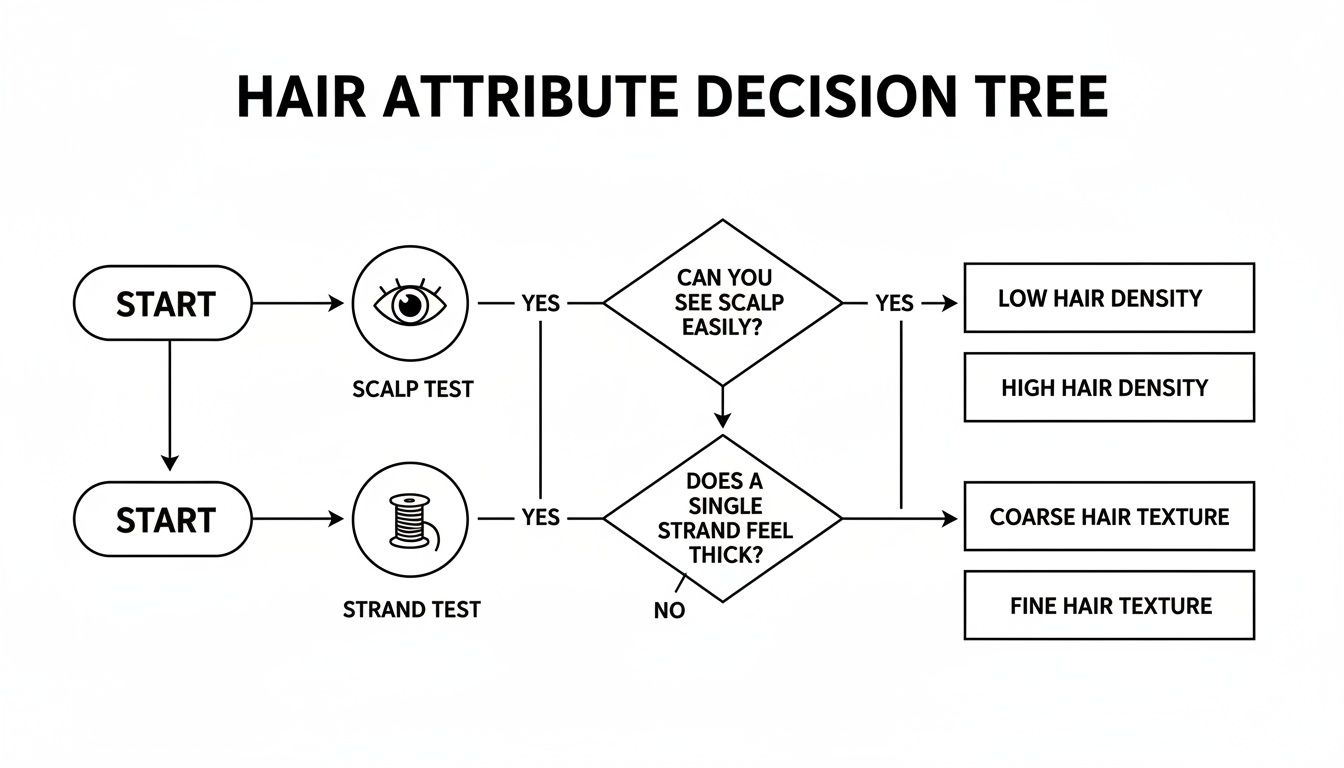
This little guide makes the scalp and strand tests much easier to interpret, helping you nail down your unique hair combo.
For Low-Porosity, Easily Weighed-Down Hair
If your hair is low porosity (often seen in Types 1A-2C), your main goal is to find products that deliver moisture without causing dreaded buildup. Your hair cuticle is sealed up tight, so heavy creams just sit on the surface.
Recommended Morfose Solutions:
You need lightweight formulas. A fantastic place to start is the Morfose Biotin Hair Mask. It provides strengthening hydration that rinses out completely clean, so it won’t leave fine or wavy hair feeling limp. For daily moisture, the Morfose Milk Therapy Creamy Mousse Conditioner is a game-changer. It gives you essential hydration in a totally weightless foam format.
Pro Tip: With low-porosity hair, always apply products when your hair is damp. The water helps spread the product evenly and encourages better absorption, preventing that heavy, coated feeling.
For High-Porosity, Dry, or Damaged Hair
If you discovered you have high-porosity hair (common in Types 3A-4C or chemically treated hair), your mission is to fill in the gaps in your porous cuticle and lock in moisture. Your hair soaks up water like a sponge but loses it just as quickly.
Recommended Morfose Solutions:
For this hair type, a strengthening treatment is non-negotiable. The Morfose Collagen Hair Mask is brilliant for fortifying the hair shaft, which helps cut down on breakage and improves elasticity. For styling, the Morfose Curly Hair Mousse delivers great definition and hold while actively fighting frizz. To add another layer of protection, finishing with one of our leave-in conditioners is the perfect final touch to keep hair soft and manageable between wash days.
Why Your Scalp Health Matters
Let's talk about the foundation of great hair: your scalp. We pour so much energy into our strands, but if the soil isn't healthy, the plant won't thrive. It’s the same with your hair. Figuring out how to know what hair type you have is incomplete if you ignore your scalp.
A happy, balanced scalp is the perfect environment for healthy hair growth. An unhappy one? That’s where things like greasy roots, constant itchiness, and frustrating flakes come into play.
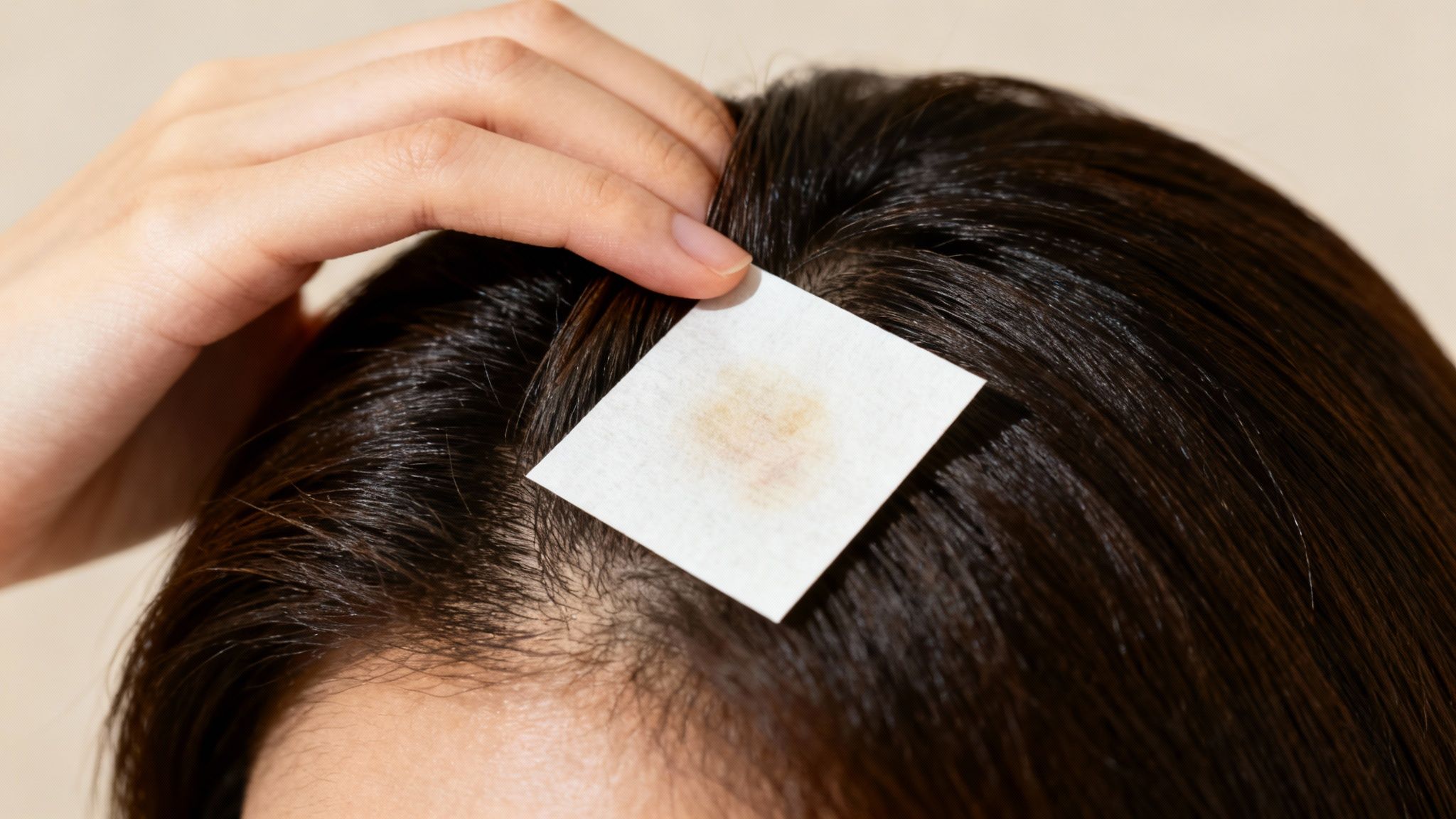
Knowing whether your scalp is oily, dry, or somewhere in the middle is a game-changer. An oily scalp can make your hair feel flat and greasy just a day after washing. A dry scalp often feels tight, itchy, and might even shed small white flakes that get in the way of healthy growth.
The Blotting Paper Test for Your Scalp
Ready for a surprisingly simple test? The Blotting Paper Test gives you a clear picture in just a few seconds. No guesswork needed.
- When to Test: The best time for an accurate reading is on day two after your last hair wash.
- How to Test: Take a clean blotting paper (a thin napkin or even tissue paper works in a pinch) and press it flat against your scalp. The crown of your head is usually a good spot. Hold it there for a few seconds.
-
Reading the Results:
- Oily Scalp: You'll see a noticeable, transparent oil blot on the paper.
- Dry Scalp: The paper will come away totally clean, with zero residue.
- Balanced Scalp: You might see a very faint, tiny trace of oil, which is completely normal.
This simple test removes the guesswork, allowing you to choose cleansers and treatments that directly address your scalp’s needs. A healthy scalp is the non-negotiable first step to achieving your hair goals.
Taking care of your scalp goes beyond just your hair type—it's about preventing bigger issues down the line. For instance, understanding what causes female hair loss often starts with scalp health. When you identify and treat your scalp’s specific condition, you’re building a foundation that supports strong, vibrant hair from root to tip.
Your Hair Type Questions Answered
As you start to figure out your hair's unique personality, a few common questions always seem to pop up. Here are some quick answers to the things people ask most when they're building a new routine from the ground up.
Can My Hair Type Change Over Time?
Absolutely. Think of your hair as a living thing—it changes right along with you. Major life events that bring hormonal shifts, like pregnancy or menopause, can completely alter your hair's texture. So can aging, chemical treatments, or even a big move to a new climate. It's a great idea to check in with your hair every few years to make sure your routine is still what your hair needs.
Is It Possible to Have Multiple Curl Patterns?
Not only is it possible, it's incredibly common. Most people don't have one uniform curl pattern. You might have tighter, springy 3B curls at the nape of your neck and looser, stretched-out 2C waves around your face. When styling, you'll get the best results by treating these different sections a little differently to get a more balanced look.
Pro Tip: Many people swear by "product cocktailing." This just means using a stronger hold gel on your looser, more stubborn sections and a lighter moisturizing cream on your tighter, drier curls to help everything blend together beautifully.
How Soon Will I See Results from My New Routine?
This is the big one! While you'll probably notice some immediate benefits—like a bit more moisture and less frizz right after your first wash day—the real magic takes time. Give your hair about 4-6 weeks of consistent care to see a significant difference in its overall health, strength, and day-to-day behavior. Patience is everything in the hair care game!
By taking the time to understand your hair's curl pattern, porosity, density, and texture, you're no longer guessing—you're making informed choices. This knowledge is the key to building an effective routine that brings out the best in your hair. Ready to stop guessing and start giving your hair exactly what it needs?
Shop the Morfose Hair Care Collection Now to find targeted solutions designed for every hair type and concern.
