
How Often Should You Deep Condition Your Hair? A Complete Guide
So, how often should you deep condition your hair? The short answer is that it depends entirely on your hair's current condition and type. For severely damaged strands, this could mean a treatment twice a week. For healthy, fine hair, once a month might be perfect. There's no one-size-fits-all rule, which means you can create a routine that’s perfectly in sync with your hair's unique needs.
This guide will walk you through creating a personalized deep conditioning schedule to achieve strong, vibrant, and healthy hair.
Your Quick Guide to Deep Conditioning Frequency
Figuring out your deep conditioning schedule is the secret to unlocking your hair's full potential. Think of it as a personalized care plan for your strands. What works wonders for someone else might be too much or too little for you. The goal is to match the intensity of your treatment to your hair's current health.
This simple decision tree is a great place to start. It'll help you find a solid baseline frequency based on where your hair is right now.
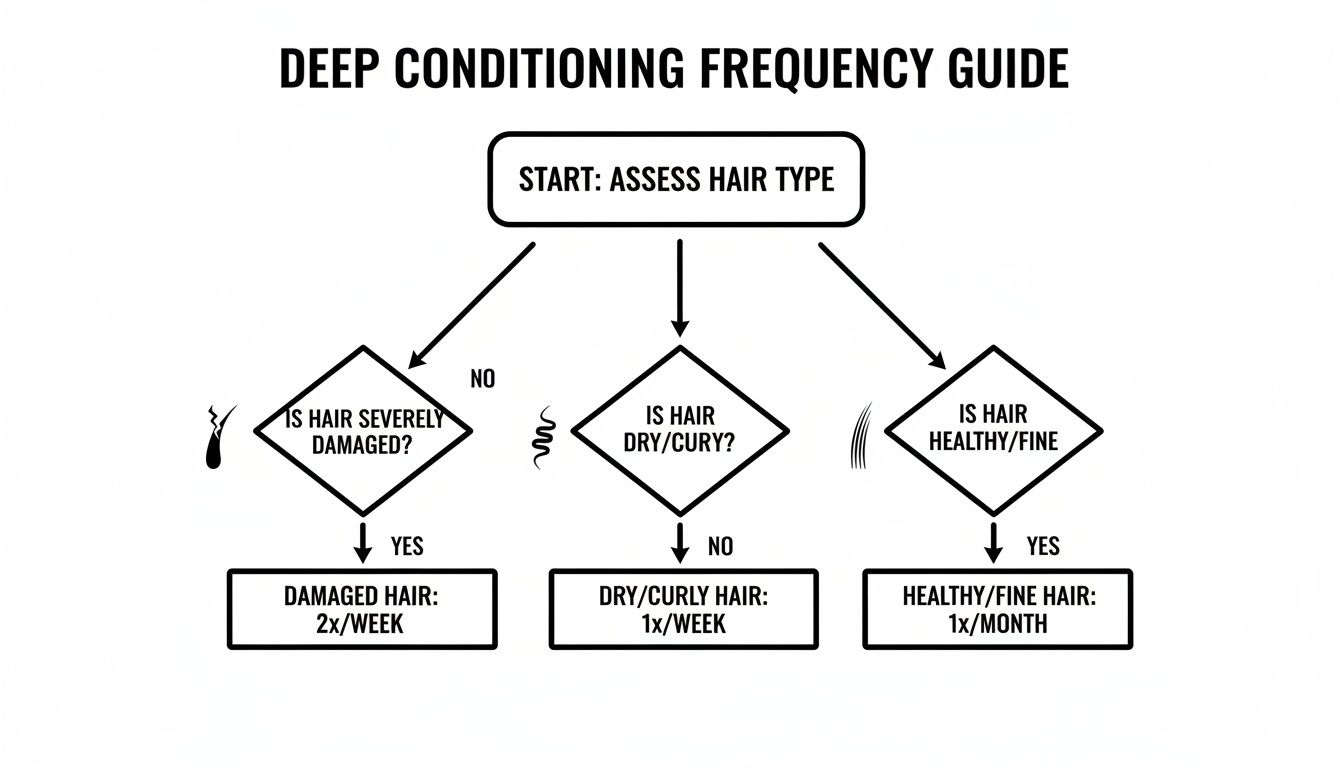
As you can see, hair that shows visible signs of damage needs more intensive care, while healthy hair thrives on a more relaxed, maintenance-focused schedule.
Start with a Baseline Schedule
To give you an immediate, actionable starting point, we put together a simple table. Find your hair's profile below to see our recommended schedule. This isn't a rigid rulebook—it's a trusted guide to get you started on the path to incredible hair health.
Deep Conditioning Frequency at a Glance
Find your recommended deep conditioning schedule based on your hair's specific characteristics.
| Hair Type / Condition | Starting Frequency | Adjusted Frequency for High Need |
|---|---|---|
| Severely Damaged or Bleached | Twice a week | Increase to 3 times for the first two weeks |
| Curly, Coily, or Textured | Once a week | Increase if hair feels exceptionally dry |
| Dry and Prone to Frizz | Once a week | Use a hydrating mask like the Morfose Argan Hair Mask |
| Fine or Low Porosity | Every 2-4 weeks | Apply from mid-lengths to ends only |
| Healthy or Normal Hair | Once a month | Maintain consistency for lasting results |
Think of these frequencies as your foundation. As we dive deeper, we'll get into the why behind these recommendations. Understanding factors like hair porosity and learning to spot the signs of over-conditioning will give you the confidence to listen to your hair and adjust your routine like a pro.
What Deep Conditioning Actually Does for Your Hair
To nail down the perfect schedule for how often you should deep condition your hair, you need to understand what’s happening on a deeper level. Many people see deep conditioning as just a more potent version of their daily rinse-out conditioner, but it’s so much more. Once you understand the “why,” you can unlock your hair's true potential.
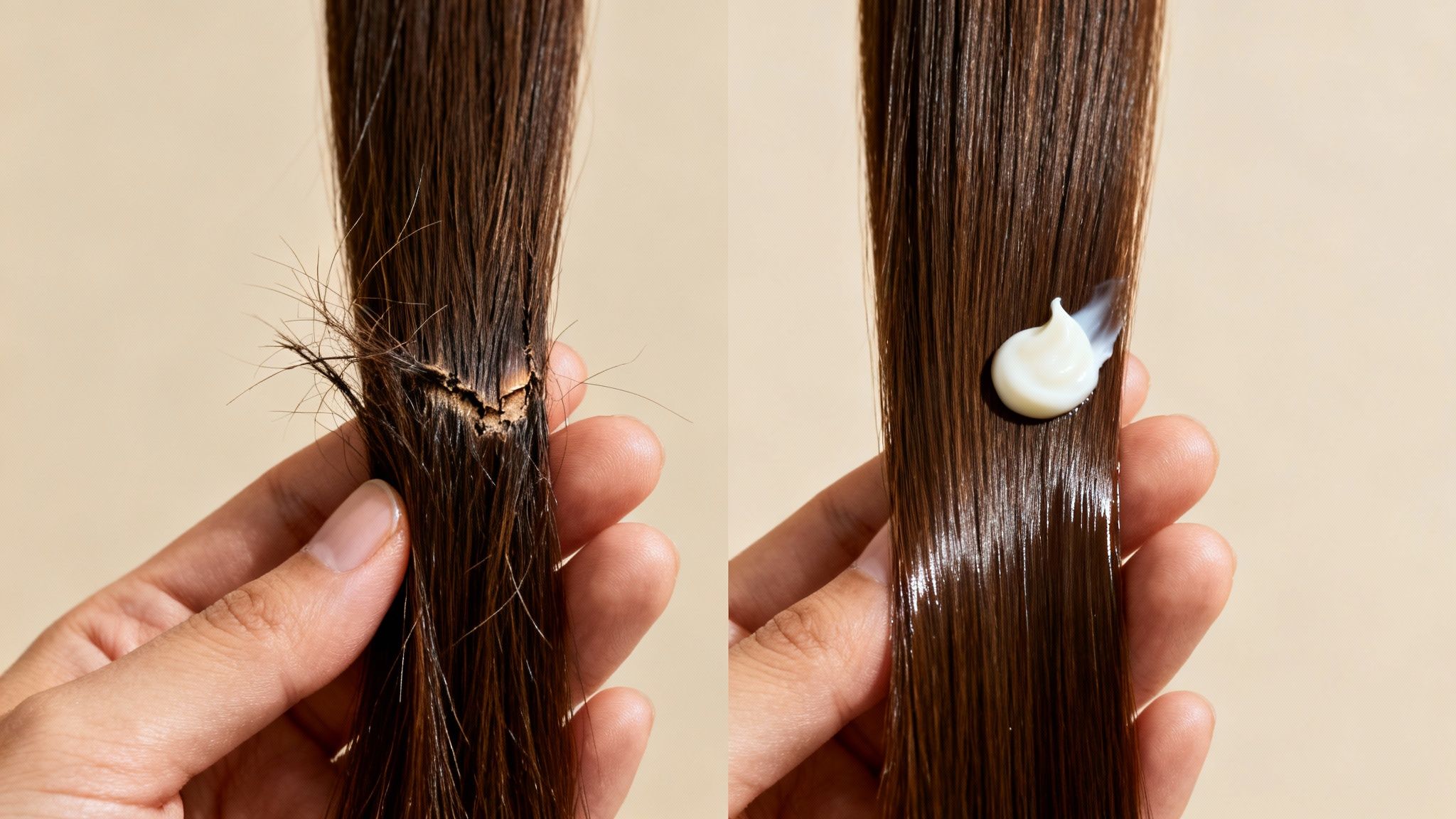
Here's an easy way to think about it: your regular conditioner is like a light, daily body lotion. It smooths the surface for a few hours, making things feel soft and manageable. It does its job, but the effects are mostly on the surface and don't last long.
A deep conditioner, on the other hand, is like a rich, restorative face mask. It’s packed with a higher concentration of hydrating and reparative ingredients designed to penetrate the hair shaft, not just sit on top.
Penetrating the Hair Shaft for Lasting Repair
The real magic happens when a deep conditioner works from the inside out. The molecules in these intensive treatments are smaller and more powerful, allowing them to slip past the hair’s protective outer layer—the cuticle.
Once inside the hair's core (the cortex), it performs three crucial jobs:
- Restoring Moisture: It injects a concentrated dose of hydration deep into the hair strand, replenishing moisture lost to heat styling, chemical treatments, or environmental factors. This is your best defense against dryness and brittleness.
- Repairing Damage: Ingredients like proteins and amino acids act like spackle, patching up weak spots and gaps in your hair’s internal structure. This process rebuilds strength, restores elasticity, and makes your hair far less likely to snap or split.
- Sealing the Cuticle: After delivering essential nutrients, the treatment helps smooth and seal the outer cuticle. A sealed cuticle is what creates a healthy, glossy shine and acts as a shield against future damage.
A regular conditioner works on the hair's surface for temporary softness. A deep conditioner penetrates the hair shaft to deliver moisture and nutrients for long-term strength and repair.
This is exactly why your deep conditioning schedule is so important. Using a product like the Morfose Collagen Hair Mask weekly isn't just pampering—it's a targeted repair session. Over time, it builds your hair's resilience, creating a strong foundation that your daily conditioner can then easily maintain.
How Your Hair Type and Porosity Determine Your Schedule
There's no one-size-fits-all answer in hair care, and your unique texture is the number one factor when figuring out how often you should deep condition your hair. What works wonders for straight, fine hair could leave curly hair feeling dry, so nailing down a personal schedule is key.
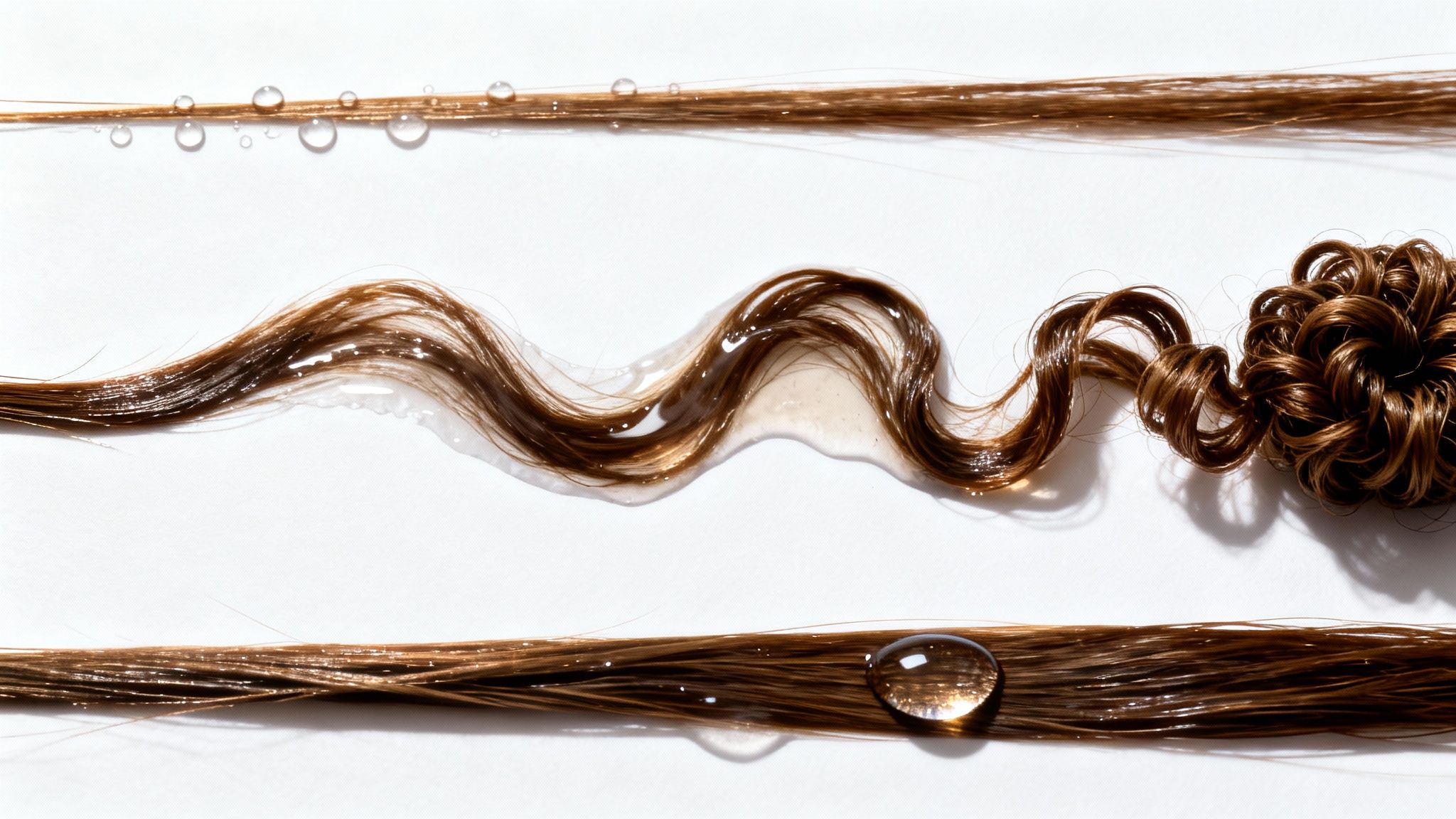
Here's an easy way to think about it: your hair type is like a roadmap for your scalp's natural oils (sebum). The straighter the road, the faster the oil can travel down to your ends.
-
Fine, Straight Hair: With a direct path from the scalp, this hair type is fairly self-moisturizing. It’s also easily weighed down by heavy products. A deep conditioning treatment once every 2-4 weeks is usually perfect for keeping it healthy without causing it to go limp.
-
Wavy to Curly Hair: The twists and turns in wavy and curly hair create detours for natural sebum. This is why the ends often feel much drier than the roots. A consistent, weekly deep conditioning session is the sweet spot for keeping these textures hydrated, defined, and frizz-free.
-
Coily and Textured Hair: Tightly coiled hair presents the most challenging journey for natural oils, making it the most prone to dryness. This hair type thrives on rich, intensive moisture. Most experts suggest deep conditioning at least once a week. For very dry or tight textures, you might even need to increase this to twice a week (8-9 treatments per month) to maintain elasticity and prevent breakage.
The Critical Role of Hair Porosity
Beyond the shape of your strands, hair porosity—your hair's ability to absorb and retain moisture—is a game-changer for your routine. It all comes down to how sealed the outer layer of your hair, the cuticle, is.
Think of your hair’s cuticle like the shingles on a roof. On low porosity hair, the shingles are flat and tight, making it hard for water to get in. On high porosity hair, the shingles are raised and open, letting water in easily but also letting it escape just as fast.
This single factor has a huge impact on how often you should deep condition. If you’re not sure where your hair lands, our guide on the differences between low vs. high porosity hair can help you figure it out.
Adjusting Your Schedule for Porosity
Once you know your hair's porosity, you can fine-tune your deep conditioning schedule for amazing results.
Low Porosity Hair
- What it's like: The cuticles are packed down tight. Hair tends to resist moisture, and products often feel like they're just sitting on top instead of sinking in.
- How often: Once a month is often plenty. It's easy to overdo it and cause buildup with this hair type. Pro tip: use gentle heat from a warm towel or steamer during your treatment to help open the cuticles and let the goodness in.
Normal Porosity Hair
- What it's like: The cuticle is slightly raised, letting moisture in and, more importantly, keeping it there. This is generally the easiest hair type to manage.
- How often: Aim for every 1-2 weeks. This simple maintenance schedule keeps your hair balanced, happy, and hydrated without overloading it.
High Porosity Hair
- What it's like: The cuticles are wide open, often from chemical treatments, heat damage, or genetics. Your hair drinks up moisture in a flash but loses it almost as quickly.
- How often: At least once a week. This hair type needs constant moisture replenishment. Your goal is to not only hydrate but also find masks that help seal the cuticle to prevent moisture from escaping.
Adjusting Your Routine for Damaged or Treated Hair
If you regularly color, bleach, or use heat to style your hair, your deep conditioning needs are in a different league. These processes are fantastic for achieving your desired look, but they work by lifting the hair’s protective outer layer—the cuticle.
This forces your hair into a state of high porosity. Think of it like a sponge with large holes; moisture rushes in, but it escapes just as quickly, leaving your strands weak, brittle, and thirsty.
For anyone with compromised hair, figuring out how often you should deep condition your hair isn’t just a good idea—it's a critical part of your repair strategy. A weekly deep conditioning session should be your non-negotiable baseline. Consider it a mandatory therapy session to restore everything that styling and coloring takes out.
Moisture vs. Protein: What Your Damaged Hair is Craving
When your hair is damaged, it’s crying out for two key things: moisture to restore its flexibility, and protein to rebuild its core structure. The trick is to use the right type of mask at the right time to avoid throwing your hair's balance out of whack.
-
Moisture Masks: These are your go-to for serious hydration. Packed with ingredients like argan oil or other hydrators, they replenish lost water, improve elasticity, and combat that dry, straw-like feeling. You'll want to use these most often, typically every week.
-
Protein Treatments: Think of these as a structural repair crew for your hair. Formulas with ingredients like collagen or keratin act like scaffolding, filling in gaps along the hair shaft to restore strength. They are powerful, but you should use them more sparingly—perhaps once or twice a month. Using them too often can lead to "protein overload," which ironically makes hair feel stiff and brittle.
When hair is chemically treated or heat-damaged, a weekly deep conditioning schedule (about 4 treatments per month) is often advised to restore moisture and reduce breakage. That’s a significant jump from the monthly treatment recommended for healthy hair. It makes sense, especially when you consider a large-scale global hair study found that a staggering 70% of people see their own hair as damaged.
Building a Restorative Routine That Actually Works
For hair that's been through a lot, consistency is your best friend. Start with a weekly deep conditioning treatment using a moisture-focused mask. This will immediately tackle the most common issue: chronic dryness.
Then, on every third or fourth wash day, swap your hydrating mask for a strengthening protein treatment. This alternating approach gives your hair a balanced diet of moisture and repair, helping it regain resilience without becoming overloaded with protein.
The best way to know if you've got the schedule right is to listen to your hair. Does it feel brittle and crunchy (needs moisture) or mushy and limp (too much moisture, maybe needs protein)? Paying attention to its texture will help you adjust this schedule perfectly. For more targeted advice, check out our guide on the best damaged hair masks and how to use them for the best results.
Best Morfose Products to Use
Knowing how often you should deep condition your hair is only half the battle. The real magic happens when you pair that knowledge with the right product—one that feels like it was made just for you. At Morfose, we’ve poured our expertise into creating treatments that target your specific hair concerns with precision.
Matching your hair’s needs with the right formula is what turns a good hair day into a great hair month.
For Chronically Dry and Thirsty Hair
Is your hair constantly begging for moisture? If you're dealing with frizz, dullness, and tangles—especially if you have curly, coily, or high-porosity strands—your hair is sending an SOS for hydration. A powerful moisture surge is your number one priority.
This is where a targeted deep conditioner completely changes the game. You need a formula that doesn't just deposit moisture but helps seal it into the hair shaft for softness and shine that lasts.
- Our Recommendation: The Morfose Argan Hair Mask is a true moisture powerhouse. Argan oil is famous for its ability to deeply hydrate and smooth the hair cuticle, making it the perfect weekly treat for anyone fighting a losing battle against frizz and brittleness.
For Weak, Brittle, and Treated Hair
If your hair has been weakened by bleach, chemical treatments, or constant heat styling, your focus needs to shift from pure moisture to structural repair. Yes, hydration is still a huge piece of the puzzle, but your strands are also craving strength to fight off breakage and regain their bounce.
A common mistake is to only use moisturizing masks on damaged hair. While that helps, your hair also desperately needs protein-based ingredients like collagen to patch up weak spots and rebuild its internal structure.
The goal here is to find a treatment that delivers a balanced diet of both strength and softness.
- Our Recommendation: The Morfose Collagen Hair Mask was formulated specifically to rebuild and fortify. Collagen works to restore your hair's essential protein structure, making it more resilient against snapping and splitting. Try swapping this in for your regular hydrating mask once or twice a month to give your hair the backbone it needs to recover and thrive.
Recognizing the Signs of Over or Under Conditioning
Your hair is always communicating its needs. The real secret to a perfect deep conditioning routine isn't about marking a date on a calendar—it's about learning to read the signals. When you can tune into what your hair needs in the moment, you can find that perfect moisture balance.
This intuitive approach makes figuring out how often you should deep condition your hair much simpler. Once you can spot the early signs of an imbalance, you can tweak your schedule before a small issue becomes a major problem.
Signs You Are Under Conditioning
If your hair is thirsty, it will let you know. Under-conditioned hair is basically screaming for a deep drink of moisture and nutrients. If any of these signs sound familiar, it’s a clear signal to increase the frequency of your deep conditioning sessions.
- Persistent Dryness: Your hair feels rough, crunchy, or straw-like, even shortly after washing.
- Excessive Frizz and Flyaways: Without enough moisture to keep the hair cuticle smooth, your hair appears frizzy and uncontrolled.
- Dull Appearance: Dehydrated hair strands cannot reflect light properly, resulting in a lackluster, matte finish instead of a healthy shine.
- Increased Tangles and Knots: Dryness creates more friction between individual strands, leading to frustrating knots that make combing a nightmare. If this is your main struggle, you can learn more about why your hair is dry and brittle and what to do about it.
Signs You Are Over Conditioning
Yes, you can absolutely have too much of a good thing. Over-conditioning, sometimes called hygral fatigue, occurs when the hair shaft becomes waterlogged. It gets so full of moisture that it starts to lose its internal structure and strength.
Over-conditioned hair often feels too soft, almost mushy when wet, and won't hold a style or curl. This is your hair's way of telling you it has an excess of moisture without enough protein to provide structure.
If your hair shows these signs, it's time to reduce the frequency of your deep conditioner or start alternating with a protein-based treatment.
- Limp, Lifeless Strands: Your hair feels heavy and weighed down, lacking its usual volume and bounce.
- Loss of Curl Definition: Your curls and waves look stretched out and undefined, refusing to hold their natural shape.
- Gummy or Mushy Texture: When wet, your hair feels unusually soft, almost like wet cotton, and might stretch more than it should before snapping.
- Greasy or Oily Feel: The hair looks and feels greasy, even right after washing, which is often a sign of product buildup.
Your Common Deep Conditioning Questions Answered
Let's wrap up by tackling some of the most frequently asked questions about deep conditioning. Getting clear answers from the start is the best way to feel confident in your routine and achieve amazing results.
Can You Leave a Deep Conditioner on Overnight?
It might seem like a good idea—more time equals more moisture, right? However, leaving a deep conditioner in your hair overnight is one of those times when more isn’t better. Most masks are formulated to deliver their maximum benefits within a specific window, usually about 20-30 minutes.
After that half-hour mark, your hair has absorbed all the nutrients it can. Leaving it on longer can backfire, leading to mushy, limp hair or a condition called hygral fatigue, where the hair shaft gets waterlogged and weakens. For a full rundown on the best application method, you can learn exactly how to deep condition hair at home.
Should You Apply It to Wet or Dry Hair?
You’ll always get the best results by applying your deep conditioner to clean, damp hair. Think of it this way: shampooing first clears the path by removing any product buildup, oils, or grime that could block the treatment from penetrating.
After shampooing, gently squeeze the excess water out with a towel so your hair is damp, not sopping wet. This creates the perfect canvas for the conditioner to work effectively. Applying it to dry hair is a waste of product—it won’t spread evenly and can’t penetrate nearly as well.
The most effective deep conditioning happens on freshly washed, towel-dried hair. This ensures the hair cuticle is open and ready to soak up all the reparative ingredients without interference from buildup.
Do You Still Need Regular Conditioner?
No! On days you treat your hair to a deep conditioner, you can skip your regular rinse-out conditioner. A deep conditioner is a much more intense, concentrated treatment that does everything your daily conditioner does, and then some.
Using both is overkill and can leave your hair feeling heavy or weighed down. Think of your deep conditioner as the final, nourishing step in your wash-day routine before you rinse it out.
By understanding your hair type, porosity, and current condition, you can tailor a deep conditioning schedule that delivers exactly what your hair needs. Consistency is key to restoring moisture, strength, and shine for your healthiest hair ever.
Ready to give your hair the targeted care it deserves? The Morfose collection of hair masks and treatments is designed to restore strength, moisture, and shine to every hair type. Find your perfect match and start your journey to healthier hair today at https://themorfose.com.
