
How Long Does It Take for Hair to Grow? Your Complete Guide
If you've ever found yourself staring in the mirror, willing your hair to grow faster, you're not alone. It can feel like a painfully slow process, especially after a haircut you regret or when you're trying to reach a new length goal. Understanding how long it takes for hair to grow can help you set realistic expectations and build a routine that truly works.
So, what's a realistic timeline? On average, hair grows about half an inch per month. That adds up to a solid six inches over the course of a year. But remember, that's just an average. Your own growth rate is completely unique, influenced by everything from your genetics to your daily habits.
Decoding Your Hair Growth Timeline
Patience is the name of the game here. One of the biggest reasons it feels like it takes forever is that not all of your hair is actively growing at the same time (more on that later!). Getting a handle on the typical speed helps you set realistic goals and appreciate the progress you are making.
This is a great way to visualize what's happening over time.
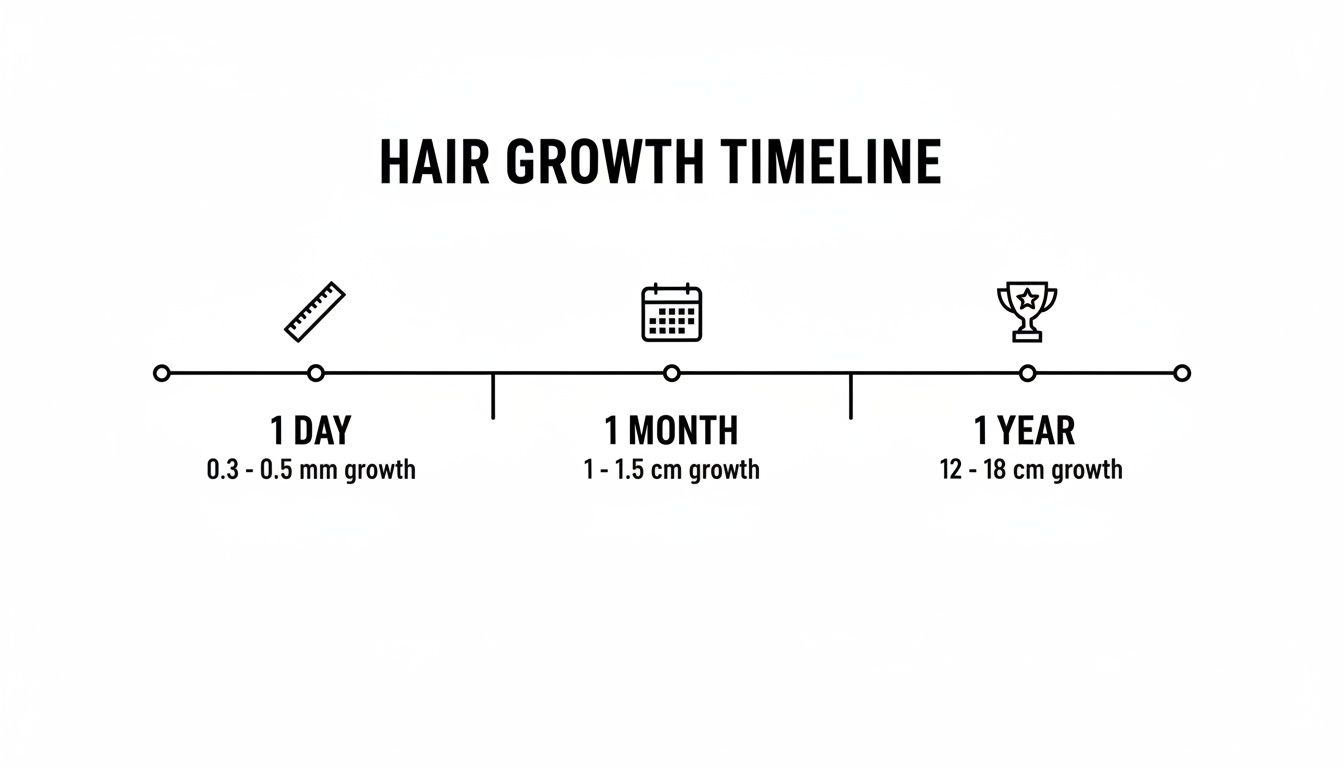
It really puts it into perspective, showing how all those tiny daily gains build up into noticeable length.
The Science Behind the Speed
Drilling down into the numbers, the average human scalp hair grows about 0.35 millimeters per day. This means that growing out a classic 12-inch bob could take around two years of solid, uninterrupted growth.
Of course, genetics and personal health can create a huge range. Some clinical studies have clocked growth rates anywhere from a sluggish 0.6 cm to an impressive 3.3 cm per month. It just goes to show how different we all are.
Here’s a quick look at what that means for some common hair goals.
Hair Growth Timeline At a Glance
| Desired Hair Length Increase | Estimated Time to Achieve |
|---|---|
| 1 Inch | Approximately 2 months |
| 3 Inches | Approximately 6 months |
| 6 Inches | Approximately 1 year |
| 12 Inches (1 Foot) | Approximately 2 years |
While this table gives you a general idea, your personal results will always depend on your unique hair cycle and how well you care for your strands.
What This Means for You
Ultimately, growing your hair long and healthy isn't just about what's happening at the scalp. It's a two-part mission: encouraging new growth and protecting the length you already have.
Think of it like this: Your body is constantly working to grow new hair, but if the ends are breaking off at the same rate, you'll never see an increase in length.
This is why a truly effective routine focuses on both nourishing the roots and preserving the ends from damage. When you get that balance right, you'll see real, lasting results.
Ready to build a routine that supports your goals? Check out our top tips for healthy hair growth.
Understanding Your Hair's Natural Growth Cycle
Finding a few stray hairs in your brush or on the shower floor can feel a little alarming, but it's actually a totally normal part of your hair's incredible, continuous lifecycle. Hair growth isn't just a random event; it's a highly structured process that unfolds in distinct phases. To really get a handle on how long it takes for hair to grow, you first have to appreciate the journey each individual strand takes.
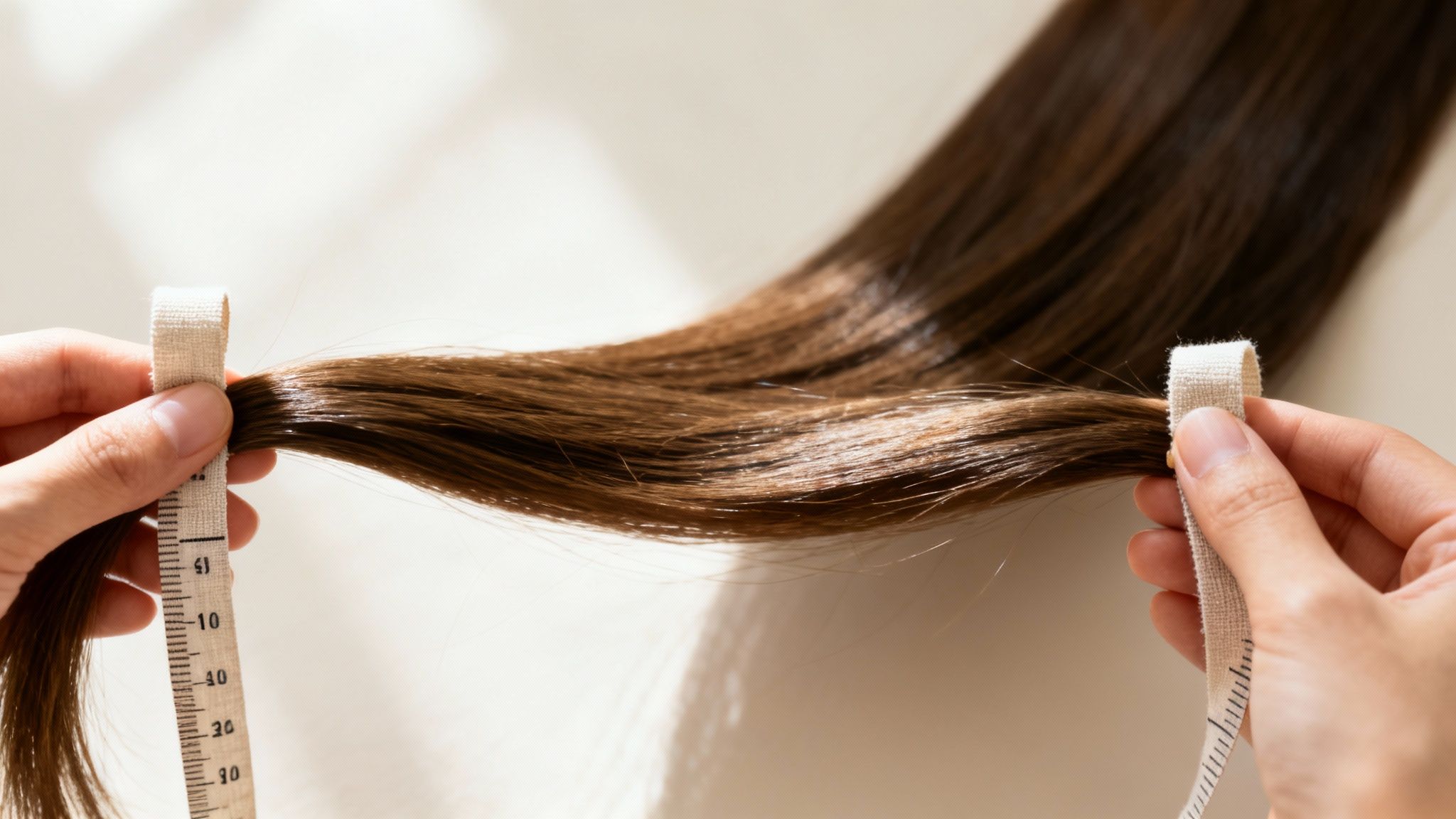
Think of the hair follicles—those tiny pockets in your scalp where hair is born—as individual workers, each operating on its own clock. They aren't all synchronized to grow or rest at the same time. This is a good thing! It's exactly why you don't lose all your hair at once.
Instead, every single follicle cycles through three main stages completely on its own.
The Three Phases of Hair Growth
Getting to know these phases is the key to setting realistic expectations and giving your hair the support it needs. Right now, every single strand on your head is in one of these three stages.
-
The Anagen (Growing) Phase: This is the main event—the active period of growth. During this time, the cells in your hair bulb are dividing like crazy to create new hair fiber. A single strand can stay in this anagen phase for anywhere from two to seven years, and the length of this phase determines the maximum length your hair can ever reach.
-
The Catagen (Transition) Phase: This is a very brief transitional stage, lasting only about two to three weeks. Growth comes to a halt, and the hair strand detaches from its blood supply, becoming what’s known as a "club hair."
-
The Telogen (Resting) Phase: Finally, the follicle chills out for a while. This resting period typically lasts for about three months. While the old, detached hair is resting, a brand new hair starts to grow underneath it, which eventually pushes the old strand out. That push is the shedding you see in your brush.
At any given time, about 85-90% of the hairs on your scalp are actively growing in the anagen phase. The other 10-15% are in the telogen phase, getting ready to make their exit. This is why shedding 50 to 100 hairs per day is completely normal and nothing to worry about.
What This Cycle Means for Your Hair Length
This staggered cycle is absolutely crucial. Because not all follicles are on the same schedule, your hair's overall length and density appear pretty consistent, even while individual strands are constantly being shed and replaced.
Real, noticeable changes in your hair's length and thickness depend on two things: how fast your hair grows and, just as importantly, how many follicles are in that active anagen phase. When things like stress, poor nutrition, or hormonal shifts cause more follicles than usual to jump into the resting phase early, you might experience more shedding than you're used to. You can learn more about how scalp health and hair growth are interconnected in our detailed guide.
Understanding this natural rhythm is fundamental to great hair care. It shines a spotlight on why a healthy scalp environment is so vital—it helps keep more follicles in that active growth phase for longer, which is the secret to reaching your hair length goals. To dive even deeper, check out the complex science of human hair growth.
Key Factors That Control Your Growth Speed
Ever feel like your friend’s hair sprouts inches overnight while yours inches along at a snail’s pace? You're not imagining things. While that half-inch-per-month average is a great benchmark, your personal hair growth speed is dictated by a unique blend of internal and external factors.
Think of it less like a fixed speed limit and more like a dynamic speedometer that fluctuates based on what’s happening inside and outside your body.
The most powerful factor is one you can’t change: genetics. Your DNA is the primary blueprint that determines the length of your anagen (growth) phase, your hair's thickness, and its ultimate potential. Some people are simply programmed for a longer growth cycle, allowing them to achieve greater lengths before a strand naturally sheds.
Age and Hormonal Shifts
Age is another major player. Hair growth typically peaks between the ages of 15 and 30. As we get older, the anagen phase naturally shortens. Some follicles may even stop producing new hair altogether, which leads to slower growth and a decrease in overall density over time.
Hormones also have a direct line to your hair follicles. Major life events like puberty, pregnancy, and menopause can cause significant hormonal fluctuations that either accelerate or slow down the growth cycle. Likewise, chronic stress elevates cortisol levels, which can prematurely push more follicles into the resting phase, resulting in increased shedding and stunted growth.
The Impact of Diet and Lifestyle
This is where you have the most control. Your hair is made primarily of protein, so a diet lacking in this essential building block can seriously hinder growth. Nutrients are the fuel for your follicles.
A deficiency in key players like biotin, iron, and zinc can put the brakes on hair production. To really get things moving, understanding these key nutrients is crucial. You can dive deeper into the best vitamins for hair, skin, and nails to see what your body might be missing.
Your hair is a non-essential tissue. This means that when your body is low on nutrients, it will divert them to vital organs first, leaving your hair follicles with the leftovers. A healthy, balanced diet is non-negotiable for reaching your hair's maximum potential.
Beyond diet, your overall health sets the stage for growth. Chronic illnesses, certain medications, and even seasonal changes can impact how fast your hair grows. In fact, studies show that scalp hair can grow about 10% faster in the summer than in the winter, likely due to increased circulation delivering more nutrients to the follicles.
This means a person averaging 0.35 mm/day in winter might see a summer increase to around 0.385 mm/day.
By focusing on these controllable factors, you create the ideal internal environment for healthy growth. To learn more about how what you eat directly impacts your strands, check out our guide on the role of nutrition in hair health.
How Morfose Helps With Healthy Hair Growth
While no single product can magically change your genetic growth rate, the right routine is absolutely essential for protecting the length you work so hard for. Think of it this way: your body is always producing new hair, but if that hair breaks off before you ever see the length, it feels like you're completely stuck. This is where a strategic haircare routine, powered by Morfose, makes all the difference.
The real secret to noticeable length isn't just about how fast your hair grows; it’s about length retention. You have to create an environment where new hair can thrive while making sure your existing strands are strong enough to handle daily wear and tear. This two-part approach—nourishing the scalp and fortifying the strands—is the key to seeing real progress.
Preserving Length by Preventing Breakage
Breakage is the number one enemy of anyone trying to grow their hair longer. Split ends, dryness, and styling damage can snap off the ends of your hair, pretty much erasing months of growth. That’s why focusing on the integrity of your strands is non-negotiable.
The Morfose Milk Therapy line was designed specifically for this challenge. Formulated with milk protein and 12 essential amino acids, these products get to work nourishing and fortifying the hair shaft from the inside out.
- Strengthens from Within: Those amino acids help rebuild the protein structure of your hair, making it far more resilient against the physical stress from brushing and styling.
- Seals in Moisture: Hydrated hair is more elastic and a whole lot less prone to snapping. Milk Therapy products replenish that lost moisture, keeping strands flexible and smooth.
- Reduces Split Ends: By keeping the hair cuticle smooth and moisturized, you can seriously reduce the formation of split ends that travel up the hair shaft and cause even more breakage.
Your hair is like a delicate fabric. Without the right care, it becomes frayed and weak. A strengthening routine acts like a protective coating, preserving its integrity so it can reach its full potential length.
Nourishing Follicles for Healthier New Growth
Of course, protecting the hair you already have is only half the battle. You also want to make sure that the new hair emerging from your scalp is as strong and healthy as possible. This all starts with targeted scalp care that gives your follicles the nutrients they need to produce high-quality hair.
A healthy scalp is the foundation for healthy hair, period. Formulas enriched with ingredients like biotin and keratin deliver essential building blocks directly to the root. These ingredients support the follicle during the anagen (growth) phase, helping it produce hair that is robust and less susceptible to breaking off prematurely. For a concentrated boost, our Morfose Scalp Treatment Anti-Hair Loss Serum provides targeted nourishment right where it all begins.
By combining a scalp-focused approach with a breakage-prevention strategy, you create a complete system that supports your hair at every single stage. You aren’t just growing hair; you're cultivating strong, resilient strands that can actually go the distance. This is how you finally see the length you’ve been waiting for.
Actionable Routines for Healthy Hair Growth
Understanding the science is one thing, but turning that knowledge into a routine is where the real magic happens. While you can't change your genetic blueprint, you absolutely can create the perfect environment for your hair to thrive and reach its full potential.
A truly effective routine is about more than just what you put on your strands. It’s a holistic approach that covers everything from the nutrients you consume to how you protect your hair from the outside world.
Fueling Growth from the Inside
Your hair is a direct reflection of what’s happening inside your body. Long before you reach for a bottle of shampoo, your first job is to give your system the essential building blocks it needs to construct strong, resilient hair.
A balanced diet loaded with protein, vitamins, and minerals isn't just a suggestion—it's non-negotiable for healthy growth.
- Protein: Hair is mostly made of keratin, a type of protein. A solid intake of lean meats, eggs, and legumes is fundamental.
- Biotin: This famous B-vitamin is a powerhouse for hair health. It helps your body metabolize the amino acids that form the very foundation of protein.
- Iron and Zinc: These two minerals are critical for keeping your follicles healthy. In fact, deficiencies in either are a well-known cause of increased shedding and sluggish growth.
And don't forget hydration. Drinking enough water is just as vital, as it helps transport all those crucial nutrients to your hair follicles, keeping them nourished and in prime working order.
Creating the Ideal Scalp Environment
Think of your scalp as the soil from which your hair grows. If it's clogged, irritated, or has poor circulation, it’s going to directly stunt the quality and speed of new growth. This is where dedicated scalp care becomes a total game-changer.
Gentle, regular cleansing is key to removing the buildup from sweat, oil, and styling products that can literally suffocate your follicles. But the real secret weapon? Stimulation.
It's been shown that regular scalp massages boost blood flow to the follicles, delivering a fresh supply of oxygen and nutrients right where you need them. This simple ritual can help awaken dormant follicles and support a long, robust anagen (growth) phase.
For a deeper look at how this works, you can explore the many benefits of scalp massages for hair growth and master some easy techniques.
When building out your routine, it also helps to get familiar with specific ingredients. For example, learning about the benefits of Aloe Vera for healthy hair can show you how powerful natural elements can be for scalp health.
Protecting Your Hard-Earned Length
Growing your hair is only half the battle—the other half is keeping it. Breakage is the number one reason people feel like their hair just isn't getting any longer. The reality is that it is growing from the roots, but it's snapping off at the ends just as fast.
A common myth is that trimming makes hair grow faster. It doesn’t. What it does is remove split ends before they can travel up the hair shaft, causing more breakage and making your hair appear shorter.
To hang on to that precious length, start building these gentle habits into your daily life:
- Minimize Heat Styling: High temperatures are one of the biggest culprits behind hair damage. When you absolutely must use heat, always shield your strands with a quality heat protectant.
- Be Gentle When Wet: Your hair is at its most fragile when it's wet. Always use a wide-tooth comb to detangle, starting from the ends and carefully working your way up to the roots.
- Use Protective Styles: Simple styles like loose braids or buns are fantastic for reducing the daily friction and tension that lead to wear and tear, helping you preserve length over time.
Got Questions About Hair Growth? We've Got Answers
Navigating the world of hair growth can feel like you're sorting through a mountain of conflicting advice. To cut through the noise, we’ve tackled some of the most common questions with direct, science-backed answers to clear up any confusion.
This quick guide is here to help you separate fact from fiction, so you can manage your hair growth journey with confidence and realistic expectations.
Does Trimming Hair Make It Grow Faster?
This is probably the most persistent myth in all of hair care. The short answer? No. Cutting your hair doesn't have any effect on how quickly it grows from the follicle.
Hair growth is a biological process that happens at the scalp. What you do to the ends has zero impact on the root.
So, why does everyone say it? The real benefit of regular trims is length retention, not growth speed. Snipping off split ends stops them from traveling up the hair shaft and causing breakage—the kind of breakage that makes it look like your hair isn't growing.
Think of a trim as a preventative measure. It's about maintaining the health of your existing hair so you can actually see the length your scalp is working so hard to produce. You're stopping breakage from erasing your progress.
Essentially, by getting rid of those damaged ends, you ensure the length you gain isn't immediately lost to snapping and fraying.
How Long Until I See a Difference with New Products?
When you start a new routine, it's totally normal to want to see results yesterday. But with hair, patience is everything. Since your hair only grows about half an inch per month on average, you have to give any new regimen time to work with your natural growth cycle.
Here's what you can realistically expect:
- For Scalp Health: Products like scalp serums get to work right away creating a healthier environment for your follicles. You might notice less itchiness or oiliness within weeks, but seeing visibly thicker, stronger new growth will take at least 3-4 months. That's how long it takes for that new, healthier hair to sprout and become noticeable.
- For Breakage Prevention: Products that strengthen your existing hair—like deep conditioners and masks—can show immediate benefits. Your hair might feel softer and more manageable after just one use. The real proof, though, is seeing less hair in your brush, which takes about 2-3 months of consistent use.
Can Stress and Diet Really Cause Hair Loss?
One hundred percent, yes. Your hair is often a direct reflection of what's going on inside your body. The link between stress, diet, and hair shedding isn't just an old wives' tale; it's a well-documented biological reality.
High levels of chronic stress can trigger a condition called telogen effluvium. This is when a large number of your hair follicles get shocked out of their active growing (anagen) phase and pushed prematurely into the resting (telogen) phase. The result? A noticeable increase in shedding about two to three months after the stressful event.
Your diet plays a massive role, too. If you're not getting enough key nutrients like iron, protein, and zinc, your body has to prioritize. Since hair is considered a "non-essential" tissue, your body will divert those resources to your vital organs first, leaving your follicles undernourished. This leads to weaker strands, sluggish growth, and, you guessed it, more shedding.
The journey to longer, healthier hair is a marathon, not a sprint. By understanding the key factors that affect hair growth and supporting your strands with a consistent, nourishing routine, you can finally reach your length goals. For products designed to protect your length and nourish your scalp, explore the full collection at Morfose.
Ready to give your hair the support it deserves? Shop our hair care solutions now!
