
Scalp Health and Hair Growth: Proven Tips for Strong Locks
Let's get one thing straight: you can't have healthy hair without a healthy scalp. It's really that simple. If you're struggling with thinning, dullness, or breakage, the problem almost always starts at the root. Focusing on your scalp isn't just another step in your routine—it's the most powerful way to get the hair you've always wanted.
Why Your Scalp Is the Foundation for Healthy Hair
So many of us pour our energy into treating the hair strands themselves. We slather on masks, oils, and conditioners hoping to mend split ends and tame frizz. While those products can help, they're essentially cosmetic touch-ups. They address the symptoms, not the cause.
Real, lasting hair health begins much deeper. Think of your scalp as the soil in a garden. You wouldn't expect vibrant, beautiful flowers to grow in soil that's dry, compacted, and lacking nutrients, would you? The same exact principle applies to the relationship between scalp health and hair growth. Your scalp is the living, breathing ecosystem that supports every single hair on your head.
The Follicle Environment Matters
Each strand of hair grows from a follicle, a tiny but complex mini-organ embedded in your scalp. When the environment on the scalp is thrown off balance, the follicle simply can't do its job properly.
- Product Buildup: Gels, hairsprays, dry shampoos, and even your scalp's natural oils can accumulate, forming a layer that literally suffocates your follicles. This blockage can physically prevent new hair from pushing through and often leads to inflammation.
- Poor Circulation: Your hair follicles need a constant supply of blood to deliver the oxygen and nutrients necessary for growth. Poor circulation is like trying to grow a plant without water—it starves the follicle and weakens the hair it produces.
- Inflammation and Irritation: Common issues like dandruff, excessive oiliness, or a dry, tight scalp create a constant state of stress. An inflamed scalp is too busy fighting irritation to focus its energy on its primary job: growing strong, healthy hair.
Your hair follicles require a healthy, balanced environment to produce strong hair. Problems like dandruff, excess oil, and product buildup can directly interfere with the hair growth cycle, leading to weaker strands and increased shedding.
Moving from Reactive to Proactive Care
Focusing on your scalp means shifting your entire approach to hair care. You stop playing defense—waiting for split ends and thinning to show up—and start playing offense. You’re nurturing the source to prevent those problems from ever taking hold. To really grasp this connection, digging into the importance of scalp care in professional hair care is a great next step.
This guide will walk you through everything you need to know to take control of your scalp's health—and your hair's future. We’ll cover the biology, the common culprits, and most importantly, how to build a routine that works for you. By getting the foundation right, you create the perfect conditions for your hair to truly flourish.
Decoding Your Scalp's Unique Ecosystem
If you really want to get a handle on hair growth, you have to look past the strands you see in the mirror. The real action happens on the scalp—a complex, invisible world that dictates the strength, thickness, and vitality of your hair.
Think of your scalp as fertile soil. For anything to grow well, that soil needs to be balanced and healthy. Your scalp is home to a community of millions of microscopic residents—bacteria, fungi, and yeasts that form the scalp microbiome. When this community is in harmony, it protects your skin, maintains the right pH, and keeps problematic microbes from taking over.
But when that delicate balance is thrown off, you get trouble. An overgrowth of the wrong microbes can lead to dandruff, relentless itching, and inflammation. This creates a hostile environment that’s the exact opposite of what your hair follicles need to flourish.
This is where the core pillars of scalp health come into play.
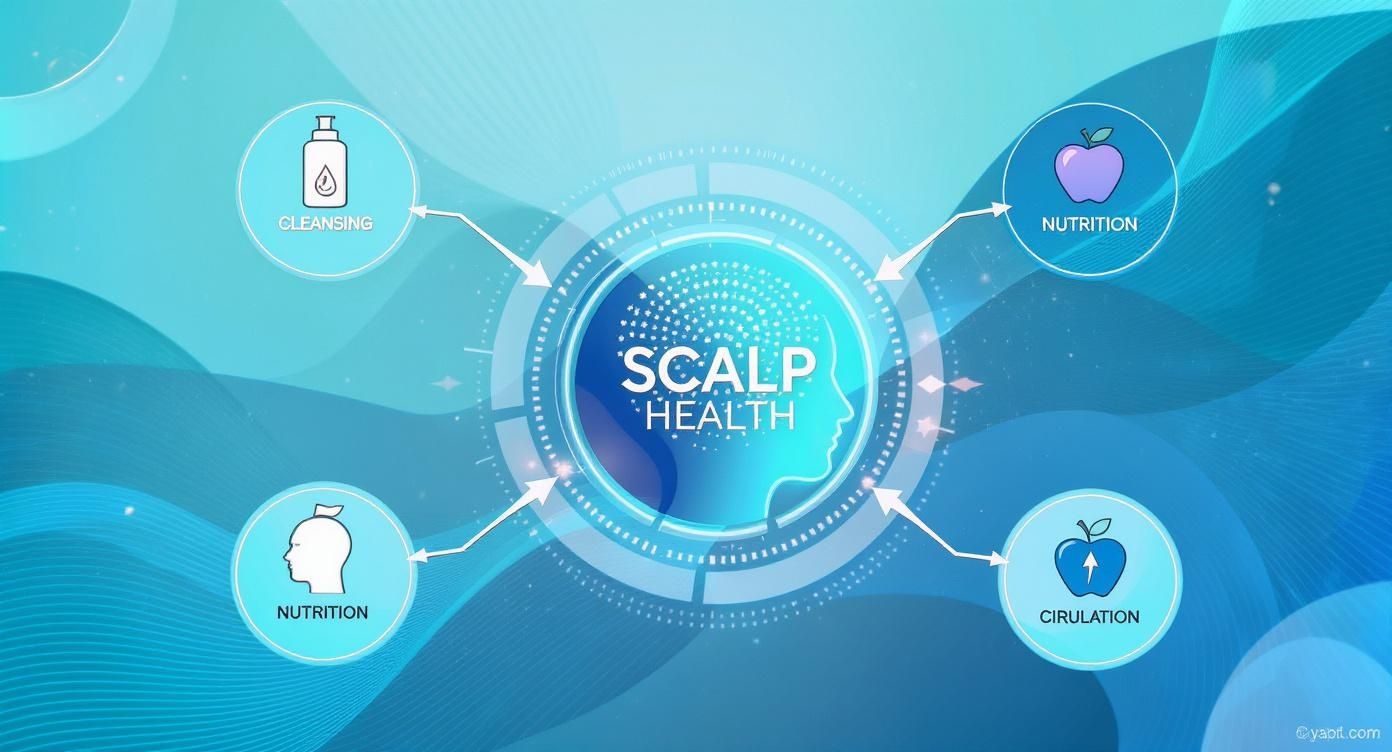
As you can see, it takes a combination of proper cleansing, good nutrition, and healthy circulation to create the harmony your scalp needs for robust hair growth.
The Rhythmic Cycle of Hair Growth
Beyond the microbiome, every single hair on your head follows a predictable, repeating cycle. Understanding this natural rhythm is key to seeing how scalp problems can directly cause thinning and shedding.
Each follicle rotates through three main phases:
- Anagen (The Growth Phase): This is the long, active period where hair is busy growing. It can last anywhere from 2 to 7 years, and at any given moment, about 85-90% of your hair is in this stage. A healthy scalp is crucial for keeping this phase going as long as possible.
- Catagen (The Transition Phase): A very short pitstop that lasts only about 10 days. The hair follicle shrinks and cuts itself off from the blood supply, bringing growth to a halt.
- Telogen (The Resting Phase): The final stage, lasting around 3 months. The hair just sits in the follicle before it’s eventually shed to make way for a new one. Once it falls out, the follicle re-enters the anagen phase and starts all over again.
When your scalp is healthy, this cycle runs like clockwork. But when it's inflamed, clogged, or stressed, it can shove hairs from the growth phase into the resting phase way too early.
This premature shift is a primary cause of noticeable hair thinning. Instead of enjoying long growth cycles, hairs are shed too soon, and the overall density of your hair begins to decrease over time.
How Scalp Imbalances Disrupt the Cycle
An imbalanced scalp directly sabotages this natural rhythm. Inflammation, whether from dandruff or heavy product buildup, can choke off blood flow. This starves the follicle of the oxygen and nutrients it desperately needs to stay in the anagen phase, forcing it to enter the shedding phase prematurely.
This disruption is a massive driver behind many common forms of hair loss. Globally, androgenetic alopecia (pattern baldness) is responsible for about 95% of hair loss cases, affecting an estimated 85% of men and 33% of women. To put that in perspective, in the United States alone, approximately 42.68% of men deal with some degree of hair loss.
Ultimately, a healthy scalp is the foundation for a healthy hair growth cycle. The first step is figuring out exactly what your scalp needs. If you’re not sure where to start, you can learn how to find your scalp type with our step-by-step guide. Knowing your starting point is the key to creating an environment where your hair can truly thrive.
Common Roadblocks to a Healthy Scalp
Even when you're doing everything right, the path to a healthy scalp and great hair can feel like one step forward, two steps back. More often than not, a few hidden culprits are quietly working against you, creating an environment that stifles growth and leads to thinning, itching, and general frustration. Getting to know these roadblocks is the first real step toward dismantling them for good.
Think of it like a garden. You can have the best seeds in the world, but if the soil is packed down, nutrient-poor, or overrun with weeds, those seeds just won't thrive. Your scalp is the soil for your hair, and if it's not in prime condition, your hair growth will suffer.
To help you pinpoint what might be going on, let's look at some common issues and how they throw a wrench in the works.
Scalp Problems and Their Impact on Hair
The table below breaks down the most frequent scalp problems, what's behind them, and how they directly affect your hair.
| Scalp Issue | Primary Cause | Effect on Hair Growth |
|---|---|---|
| Product Buildup | Silicones, waxes, and heavy oils from styling products. | Clogs follicles, preventing new hair from emerging and causing inflammation. |
| Dandruff | Overgrowth of Malassezia yeast, leading to inflammation. | Inflammation and scratching damage follicles, leading to shedding and weaker hair. |
| Psoriasis | Autoimmune response causing rapid skin cell turnover. | Creates thick plaques that physically block follicles and disrupt the growth cycle. |
| Hormonal Thinning | Genetic sensitivity to the hormone DHT. | Shrinks hair follicles (miniaturization), leading to progressively finer, shorter hairs. |
| Nutrient Deficiency | Lack of key vitamins and minerals like iron, zinc, and biotin. | Deprives follicles of the building blocks needed for strong hair, causing brittle strands. |
Recognizing these patterns is crucial because you can't fix a problem until you know what it is. Each issue requires a slightly different approach to get your scalp back in balance.
Product Buildup: The Silent Suffocator
One of the sneakiest and most common issues I see is product buildup. We all love our dry shampoos, styling creams, and serums, but many contain ingredients like silicones, waxes, and certain polymers that cling to the scalp. Over time, they layer up, mixing with your natural oils and dead skin cells.
This creates a dense film that effectively suffocates your hair follicles. A clogged follicle is an unhappy one—it gets irritated, inflamed, and can physically block new hair from pushing through. If your hair feels heavy, looks greasy soon after washing, or you're shedding more than usual, buildup could be the culprit.
Think of it this way: your scalp needs to breathe. When it's caked in a layer of old product, it's like trying to breathe through a thick blanket. It's an impossible environment for healthy hair to grow in.
Inflammatory Conditions That Sabotage Growth
Inflammation is public enemy number one for a healthy scalp. When your scalp is inflamed, your body goes into defense mode, diverting all its energy to fighting the irritation instead of focusing on growing hair.
Here are a few of the biggest instigators:
- Dandruff (Seborrheic Dermatitis): This isn't just about a few flakes. It's often caused by an overgrowth of a yeast called Malassezia, which sends skin cell turnover into overdrive. The constant inflammation and scratching can seriously weaken hair follicles, leading to temporary hair loss. If this sounds familiar, you can explore the 7 best ways to get rid of dandruff according to dermatologists for targeted solutions.
- Psoriasis: This is an autoimmune condition where the body’s own defense system mistakenly attacks skin cells, causing them to multiply way too fast. It creates thick, scaly, red patches that are often painful and severely disrupt the hair growth cycle.
- Folliculitis: Simply put, this is an infection of the hair follicles, usually bacterial. It looks like small, pimple-like bumps around the hair shaft, and if left untreated, severe cases can cause permanent damage.
The Role of Hormones and Genetics
Sometimes, the problem isn't on the surface but comes from within. Hormones are the master regulators of the hair growth cycle, and when they're out of balance, your hair is one of the first things to show it.
The most notorious player is dihydrotestosterone (DHT), a derivative of testosterone. For those with a genetic predisposition, DHT attaches to hair follicles and causes them to shrink over time. This process, known as miniaturization, is the core mechanism behind androgenetic alopecia (pattern baldness) in both men and women. If you're dealing with thinning, it's helpful to understand all the options available, such as supplements like Locerin for hair loss support.
Lifestyle Triggers: Stress and Nutrition
Never underestimate the power of your daily habits. Your scalp is a direct reflection of your internal health, and two of the biggest influencers are stress and nutrition.
When you're under chronic stress, your body pumps out the hormone cortisol. High cortisol levels can prematurely shove a large number of your hair follicles from the growth phase into the resting (or shedding) phase. This can trigger a sudden and alarming amount of hair fall, a condition called telogen effluvium.
Likewise, a diet that’s missing key building blocks—like iron, zinc, protein, and B vitamins—is like asking a construction crew to build a house without bricks or wood. Your follicles are starved of the raw materials they need to produce strong, healthy hair, resulting in weak, brittle strands.
These issues are incredibly common. In fact, the market for hair thinning treatments was valued at USD 1.51 billion recently and is expected to climb to USD 2.75 billion by 2030. This isn't just a niche concern; it's a global one, showing just how many people are waking up to the importance of scalp health. The first step is always awareness—and now you know exactly what to look for.
How to Perform a Simple At-Home Scalp Check
You don't need a trip to the dermatologist to get a read on your scalp's health. Think of yourself as a scalp detective—a few minutes in front of your bathroom mirror can reveal exactly what your scalp is trying to tell you. Regularly checking in helps you catch small issues before they become big problems, which is key for maintaining great scalp health and hair growth.
It's just like checking the soil before you plant a garden. Is it parched and dry? Overly damp? Or is it just right? A quick, consistent check-up puts you in control, allowing you to give your scalp what it needs, when it needs it.
The Visual Inspection
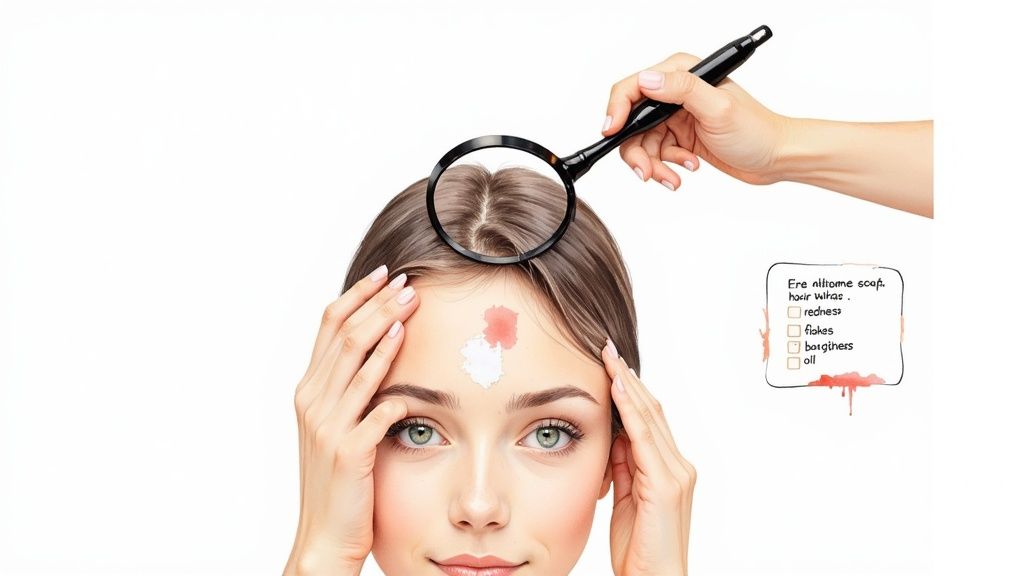
First things first, find some good lighting—natural daylight is best. Part your hair in a few different places to get a good, clear look at the skin underneath. You’re searching for the tell-tale signs that something is out of whack.
Here’s a quick checklist for what to look out for:
- Color: A healthy scalp should look pretty much like the skin on the rest of your body—calm and evenly toned. If you see angry red patches or persistent pinkness, that’s a clear sign of inflammation, which is a major enemy of hair growth.
- Flakes: What kind of flakes are you seeing? Are they small, white, and powdery, like a sign of dryness? Or are they larger, yellowish, and a bit greasy? Knowing the difference is crucial because it points you toward the right solution.
- Shine: If your scalp looks overly shiny or greasy soon after washing, that’s a clue you’re dealing with excess sebum. That oily environment can easily clog up your hair follicles, creating problems down the line.
The Tactile Test
Now, it’s time to use your sense of touch. Your fingertips are surprisingly good at detecting issues you can’t see. Just make sure your hands are clean, then gently run your fingers across different parts of your scalp.
Pay close attention to these feelings:
- Texture: Does your scalp feel smooth and supple? Or do you feel little bumps, rough scaly areas, or even small pimples? Those bumps could be anything from product buildup to folliculitis.
- Moisture Level: How does it feel to the touch? Is it greasy and slick, or does it feel tight, dry, and almost stretched? Either extreme is a sign that your scalp's natural balance is off.
- Soreness: Press down gently in several spots. Any tenderness, outright pain, or soreness is a big red flag for inflammation that needs to be addressed.
A healthy scalp should feel pliable, hydrated, and comfortable. If you’re feeling tightness, pain, or any weird textures, that’s your scalp’s way of sending up a flare signal that it needs help.
Symptom Tracking
Finally, start keeping a simple log—either in your head or in a notebook—of how your scalp feels from day to day. Symptoms can change based on your diet, stress levels, or the products you use, so tracking them helps you connect the dots.
Jot down any patterns you notice related to:
- Itchiness: Is it a constant, low-grade annoyance? Or does it flare up right after you use a certain shampoo? An itchy scalp almost always leads to scratching, which can do real physical damage to the hair follicles.
- Soreness or Pain: Note where you feel it and when. Is it a dull, constant ache or more of a sharp, specific pain?
- Shedding: Losing 50-100 hairs a day is totally normal. But if you suddenly start seeing way more hair in your brush, on your pillow, or clogging the shower drain, it's a critical sign that your scalp’s health might be in trouble.
By making these quick visual, tactile, and symptom checks a regular habit, you stop guessing and start knowing what’s going on up there. This simple assessment is the most important first step toward building a routine that gives your scalp the support it needs for strong, healthy hair.
Building Your Ultimate Scalp Care Routine
Now that you understand what makes a scalp happy, it's time to put that knowledge into practice. A dedicated scalp care routine isn't about making your life more complicated; it’s about creating a simple, repeatable system that directly supports scalp health and hair growth. Think of it like a skincare routine—consistency is what unlocks real, lasting results.
This whole process boils down to four key stages: Cleanse, Exfoliate, Treat, and Nourish. Each step has a unique job to do, but they all work together to create a balanced environment where your hair follicles can finally thrive. It’s a complete support system for the foundation of your hair.
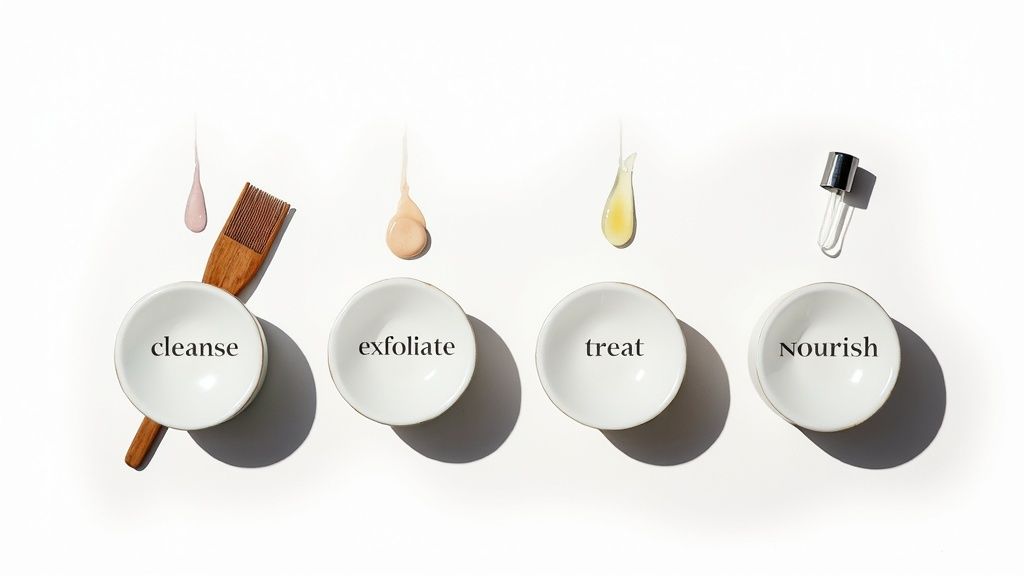
Step 1: Cleanse The Right Way
Proper cleansing is the absolute cornerstone of scalp health. The goal is simple: remove the daily grime, excess oil, and product residue without stripping your scalp of its natural moisture. If you wash too often, you can dry out your scalp, which can kick oil production into overdrive. But if you don't wash enough, buildup can accumulate and literally suffocate your follicles.
Finding your perfect washing rhythm is personal, but here are some solid guidelines to start with:
- Oily Scalps: You’ll likely feel best washing every 1-2 days to keep oiliness in check and pores clear.
- Dry or Sensitive Scalps: Try washing every 3-4 days. This helps preserve those precious natural oils.
- Normal Scalps: You’re probably somewhere in the middle, hitting a sweet spot around every 2-3 days.
When you shampoo, get the product right onto the scalp. Use the pads of your fingers—never your nails!—to gently massage it in. Not only does this get your scalp truly clean, but it also gets the blood flowing, which is fantastic news for your follicles.
Step 2: Exfoliate To Decongest
You exfoliate your face, right? Your scalp needs that same love. This step is a game-changer because it goes deeper than shampoo, breaking down the stubborn gunk left behind from dead skin cells, oil, and products like dry shampoo. When your scalp can breathe, your follicles can function without anything holding them back.
You’ve got two main options here:
- Physical Exfoliants: These are scrubs that use fine particles (think sugar or salt) or tools like a scalp massager to physically lift away all the buildup. They give you that instantly clean feeling and are amazing for boosting circulation.
- Chemical Exfoliants: These use gentle acids, like salicylic or glycolic acid, to dissolve the gunk holding dead skin cells together. They offer a deeper, more even exfoliation without any harsh scrubbing.
To start, aim to exfoliate just once a week. It’s easy to overdo it, and an irritated scalp is not the goal. Pay attention to how your scalp feels and adjust from there.
Step 3: Treat Targeted Concerns
This is where you get to customize your routine and really zero in on your specific scalp issues. Whether you’re dealing with dryness, relentless oil, thinning, or irritation, the treatment step delivers concentrated ingredients right where you need them. It's the scalp-care equivalent of a powerful face serum.
Targeted treatments are your secret weapon. Whether it's a calming lotion for an itchy scalp or a growth-stimulating serum for thinning areas, this step provides a potent, focused solution to your biggest scalp challenges.
A high-quality scalp serum, for instance, can deliver a cocktail of nutrients, peptides, and botanical extracts straight to the hair follicle. Shampoos designed for specific problems, like a clarifying wash for buildup or an anti-dandruff formula, also count. The key is to apply these powerful products to a clean, exfoliated scalp so they can be absorbed effectively and get to work.
Step 4: Nourish And Protect
The final step is all about putting moisture back in and protecting your scalp's delicate barrier. A well-nourished scalp is a resilient one—it's less prone to irritation and is perfectly prepped to support strong, healthy hair. This can be as simple as using a hydrating conditioner on your scalp or as intentional as applying a leave-in scalp tonic.
Giving yourself a scalp massage during this step is an incredible way to amplify the benefits. A gentle, five-minute massage boosts blood flow, which is crucial for delivering oxygen and nutrients to your hair roots. You can discover the benefits of scalp massages for hair growth and easily add the technique to your routine. It’s a small habit that can make a huge difference over time.
It’s clear people are catching on. In the United States alone, spending on hair loss products was projected to hit USD 2.22 billion in a recent year, and the global market is on track to reach a staggering USD 88.18 billion by 2030. This massive interest shows just how much people value their hair and scalp health. By embracing a complete routine, you’re making a smart investment in the future of your hair, starting right at the source.
Lifestyle Habits That Supercharge Scalp Health
While the right products are a huge part of the equation, your daily habits play an equally powerful role in achieving real scalp health and hair growth. You can think of it this way: a healthy scalp is built from the inside out. Everything from what you eat to how you handle stress directly impacts your hair.
Your routine in the shower is important, but the choices you make the other 23 hours of the day are what provide your follicles with the foundation they need to truly thrive.
Fuel Your Follicles with Smart Nutrition
Think of your hair follicles as tiny, hard-working factories. To produce strong, healthy hair, they need a constant supply of raw materials—and those materials come from your diet. It's no surprise that when your nutrition is off, your hair is often the first thing to suffer.
To build resilient hair from the cellular level up, make sure your diet is rich in a few key players:
- Iron: This mineral is a must-have for producing hemoglobin, which is responsible for carrying oxygen to all your cells. Your hair follicles are no exception and need that oxygen for growth and repair.
- Zinc: A zinc deficiency is a known cause of hair shedding because it throws the entire hair growth cycle out of whack.
- Biotin: Famous for a reason, this B-vitamin is essential for producing keratin, the very protein that makes up your hair.
- Protein: Since your hair is literally made of protein, getting enough in your diet is non-negotiable for building strong strands.
Loading up on foods like leafy greens, eggs, nuts, and fish is a fantastic way to cover these bases. If you want to learn more, check out our guide on the role of nutrition in hair health and start eating your way to better hair.
Your diet is the primary source of the building blocks for your hair. A nutrient-rich eating plan is one of the most effective long-term strategies for promoting scalp vitality and encouraging consistent growth.
Manage Stress to Protect Your Hair Cycle
Chronic stress is one of the biggest hidden enemies of healthy hair. When you're constantly stressed, your body pumps out a hormone called cortisol. Over time, high cortisol levels can shove a shocking number of hair follicles from their active growing phase straight into the resting phase—which is followed by shedding.
This condition, known as telogen effluvium, is a common cause of sudden, noticeable thinning. Finding healthy ways to manage your stress isn't just a mental health practice; it's a critical step in protecting your hair.
It doesn't have to be complicated. Simple things like daily walks, meditation, or just carving out time for a hobby you enjoy can help keep cortisol in check and your hair cycle running smoothly.
Adopt Hair-Friendly Physical Habits
Finally, a few small adjustments to your daily physical habits can make a world of difference in preventing unnecessary strain on your scalp and hair.
- Avoid Tight Hairstyles: That super-tight ponytail or bun might look sharp, but the constant pulling can lead to traction alopecia—a type of hair loss caused by prolonged tension on the follicles. Give your hair a break.
- Gentle Handling: Be mindful when you brush or towel-dry your hair. Ripping through tangles or aggressively rubbing with a towel causes breakage and can seriously irritate your scalp.
- Incorporate Massage: A quick nightly scalp massage does more than just feel good. It boosts circulation, delivering a fresh wave of oxygen and nutrients right where they're needed most: your hair roots.
For an extra natural boost, you might also look into herbal supplements. For example, Shavegrass (Equisetum arvense) supplements are well-regarded for their silica content, which supports hair vitality. By combining a great product routine with these supportive lifestyle habits, you’re creating a complete ecosystem for your best hair ever.
Your Top Questions About Scalp Health and Hair Growth, Answered
When you start digging into scalp care, it's natural for a bunch of questions to pop up. Let's tackle some of the most common ones with clear, no-nonsense answers to help you build a routine that actually works.
How Often Should I Wash My Hair for a Healthy Scalp?
Honestly, there's no one-size-fits-all rule here. The best washing frequency comes down to your unique scalp type.
If you have an oily scalp, you might find that washing daily or every other day is essential to control sebum and prevent follicle-clogging buildup. On the flip side, if your scalp is on the dry or sensitive side, washing just two or three times a week is often plenty. The key is to find that sweet spot where your scalp feels clean, but not stripped of its natural, protective oils.
Can Scalp Massage Actually Stimulate Hair Growth?
Yes, it can, and the science behind it is pretty straightforward. Think of a gentle scalp massage as a dedicated delivery service for your hair roots.
By physically stimulating the scalp, you increase blood flow to the area. This enhanced circulation brings a rush of oxygen and vital nutrients directly to your hair follicles, creating a more fertile environment for growth and potentially extending the anagen (growth) phase of the hair cycle.
Are Sulfates in Shampoo Really That Bad for My Scalp?
Sulfates are incredibly effective detergents—sometimes a little too effective. For people with sensitive, dry, or eczema-prone scalps, they can be a real problem.
Their powerful cleansing action can strip away the scalp's natural moisture barrier, which can lead to that tight, itchy, and irritated feeling after you wash. If that sounds familiar, making the switch to a gentler, sulfate-free shampoo is a very smart move.
Ready to build a routine that answers all your scalp’s needs? Explore the targeted scalp therapies and nourishing formulas from Morfose to create the perfect foundation for healthy, beautiful hair. Shop the collection now.
